

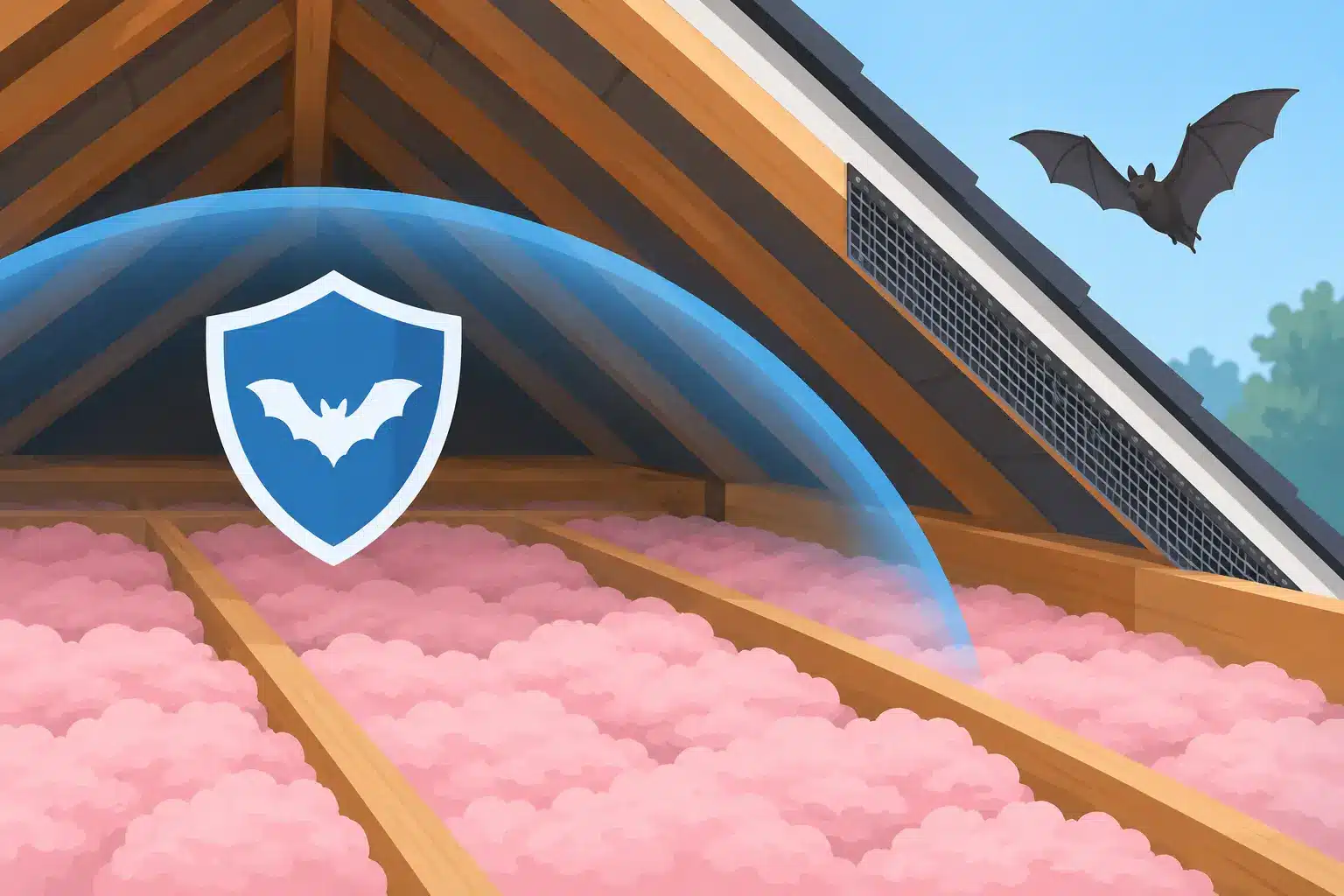
A bat colony can turn clean attic insulation into a contamination problem long before you see a bat indoors. Learning how to protect attic insulation means addressing the source of the problem – active bat access – before focusing on cleanup. Insulation can trap guano, urine, odor, insects, and moisture, leaving homeowners and property managers with damage that spreads beyond the original roosting area.
The right response is not to trap bats inside or seal every gap overnight. Bats must be removed through safe, humane exclusion, then the attic needs to be assessed for contamination and restored properly. Every Bat Deserves a Home, Just Not Yours.™
Why Bats Damage Attic Insulation
Bats do not chew through insulation like rodents, but an active colony can still cause serious damage. They commonly roost along rooflines, behind chimney flashing, in soffits, or near attic vents. As they enter and exit night after night, droppings accumulate beneath the roosting area and work their way down through loose-fill or batt insulation.
Guano is more than an odor issue. Large accumulations can compress insulation, reduce its ability to hold conditioned air inside the building, and create conditions that attract insects. Urine can stain framing, dampen insulation, and contribute to stubborn odors that are especially noticeable during warm weather or when the HVAC system is running.
The longer a colony remains, the more widespread the issue can become. A small amount of localized droppings may be manageable after professional evaluation. Insulation that is heavily soiled, matted, wet, or odor-saturated often needs to be removed and replaced.
How to Protect Attic Insulation Before Damage Spreads
The best protection is early action. If you hear chirping or scratching near the roofline at dusk, notice dark staining around an opening, or find small pellet-like droppings below attic gaps, schedule an inspection promptly. Bats can enter through openings as small as about 3/8 inch, so what looks like a minor construction gap can be a regular access point.
Identify the active entry points
Attics may have more than one entry route. Common problem areas include gable vents, ridge vents, damaged screens, gaps at fascia boards, utility penetrations, chimney intersections, and roof-to-wall transitions. A professional inspection looks for the main exit point as well as secondary gaps that bats could use once the primary opening is blocked.
Do not rely on a quick daytime attic check alone. Bats are often tucked into tight voids, and their actual exit points may be outside the area where guano is visible. Exterior inspection at the right time of day helps confirm where bats are leaving the structure.
Use humane exclusion, not trapping or poison
Once entry points are identified, the correct solution is exclusion. One-way devices allow bats to leave the building but prevent them from returning. After the bats have exited, entry points can be permanently sealed with materials suited to the building’s construction.
Sealing gaps while bats are still inside can force them into wall voids or living spaces. It can also create an inhumane outcome and leave dead bats behind, which adds odor and sanitation concerns. Poison is never an appropriate solution for bats and can create legal, health, and wildlife problems.
Timing matters as well. During maternity season, flightless pups may be present in a colony. Excluding adult bats at the wrong time can separate mothers from pups that cannot leave. A bat specialist can determine the proper approach and timing based on conditions at the property.
Protect clean insulation during the work
If insulation is not heavily contaminated, it may be possible to preserve portions of it. The work area should be controlled so guano and dust are not tracked into clean sections of the attic or into the living space below. Professionals use appropriate protective equipment and containment practices when handling affected material.
Avoid sweeping, vacuuming, or disturbing dry guano yourself. Disturbance can send dust and fungal spores into the air. Household vacuums are not designed for this type of cleanup and can spread fine particles rather than safely contain them.
Decide Whether Insulation Can Be Cleaned or Replaced
Not every bat issue requires a full attic insulation replacement. The decision depends on how much material is affected, the depth of contamination, the insulation type, and whether urine odor or moisture has reached the framing or ceiling surfaces.
Localized contamination near a known roosting site may allow for targeted removal and sanitation. In a larger infestation, guano can be distributed across broad areas of loose-fill insulation, particularly where bats have used the attic for multiple seasons. When contamination is widespread, removing affected insulation is usually the more reliable way to restore sanitation, indoor air quality, and thermal performance.
After removal, the attic should be cleaned and evaluated for damaged wood, stained drywall, compromised ductwork, and ventilation concerns. Only after the bat entry points are permanently sealed should new insulation be installed. Reinsulating first and delaying exclusion risks contaminating the new material all over again.
Keep Moisture and Other Pests From Compounding the Problem
Bats are the priority when a colony is active, but attic conditions also affect how well insulation holds up after exclusion. Moisture from roof leaks, poor ventilation, bathroom exhaust fans venting into the attic, or ice-dam damage can cause insulation to clump, sag, or lose effectiveness. Those conditions can also make lingering odor more noticeable.
After bat removal and cleanup, inspect the attic for wet spots, visible mold, blocked vents, and disconnected ducts. Repairing these issues protects new or remaining insulation and helps preserve the building envelope.
Rodents and insects can also take advantage of the same openings bats use. Once the bat exclusion work is complete, professionally sealing the exterior gaps helps reduce the chance of mice, squirrels, birds, and insects entering through vulnerable roofline areas. The materials and methods matter because a patch that looks secure from the ground may fail after a season of wind, snow, and temperature changes.
Watch for Signs That Bats Have Returned
A properly excluded building should stay bat-free, but property owners should still pay attention during the next active season. Check the roofline occasionally for fresh staining, new droppings below vents or eaves, or bats circling and entering the same area at dusk.
Inside, persistent odor, fresh guano, or renewed chirping can indicate an overlooked opening or a new gap caused by storm damage, aging caulk, or shifting building materials. Addressing a small opening quickly is far easier than waiting for another colony to establish itself.
For churches, apartment buildings, warehouses, and other commercial properties, monitoring is especially valuable because the roofline may be extensive and the attic may contain mechanical equipment, ducts, or insulation over large areas. A targeted inspection can identify risk areas without disrupting occupants or daily operations.
When to Call a Bat Specialist
Call for professional help when bats are actively entering or leaving the building, guano is visible in the attic, odor is spreading into occupied areas, or you are unsure whether young bats may be present. This is not a job for general sealing alone. The building must be assessed for bat behavior, entry points, exclusion timing, contamination, and long-term repairs.
CP Bat Mitigation provides safe, humane bat removal, proven exclusion methods, and cleanup guidance for homes and commercial properties throughout the Midwest. A thorough inspection gives you a clear picture of what is happening overhead and what it will take to keep it from happening again.
Your attic insulation quietly protects the rest of your property every day. Give it the same protection in return: stop bat access correctly, handle contamination safely, and make permanent repairs before a small roost becomes a major restoration project.