

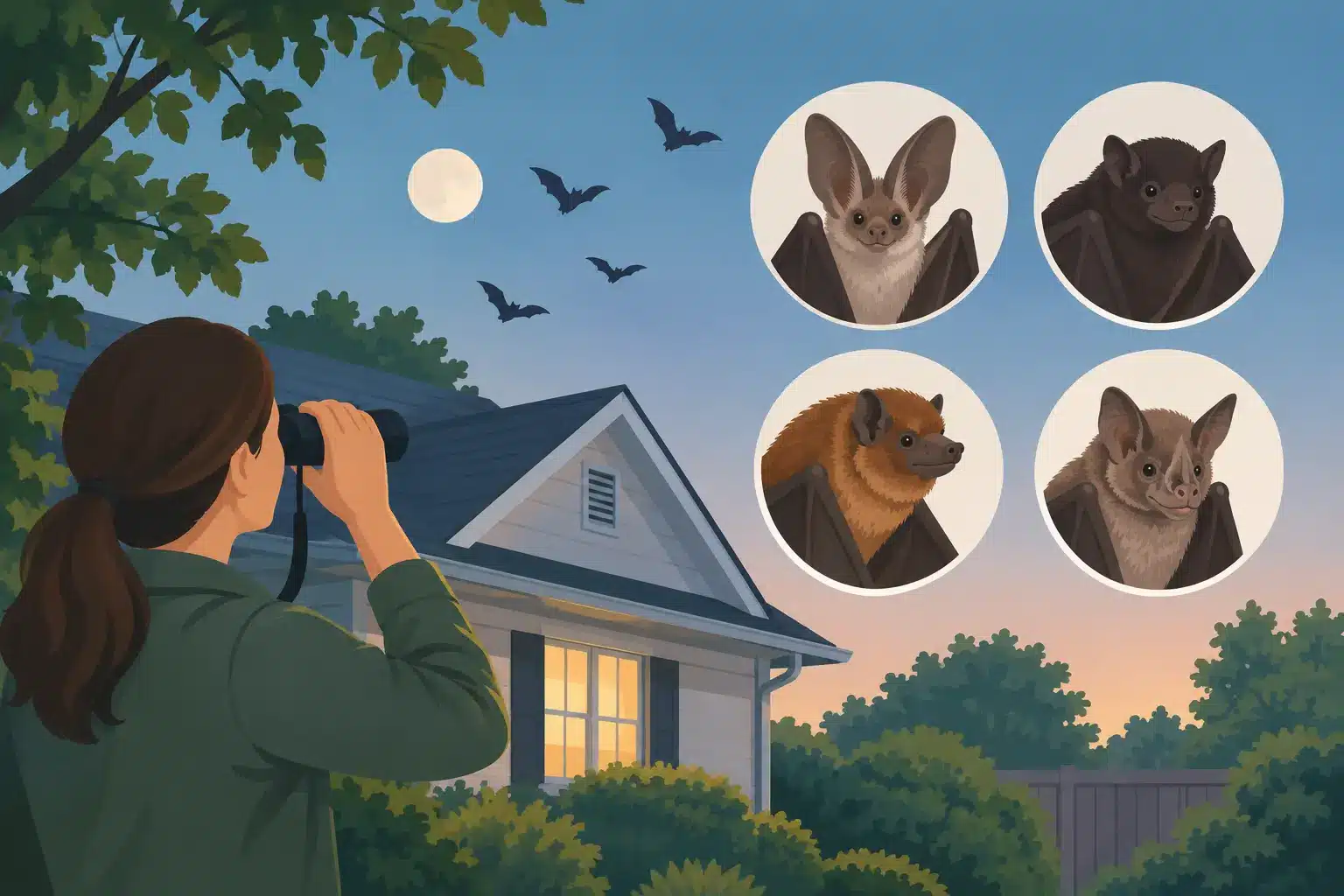
A bat slipping out from beneath a soffit at dusk can look like any other bat to the naked eye. That is why learning how to identify bat species starts with more than color or wing shape. For homeowners and property managers, the useful question is whether bats are using your building, where they are entering, and whether young bats may be present before any exclusion work begins.
Correct identification helps guide safe, humane bat removal. It can also explain why a colony selected a particular attic, church steeple, warehouse roofline, or wall void. Still, species identification from a distance has limits. Many North American bats are protected wildlife, and handling one yourself is never the right way to get an answer.
How to Identify Bat Species Safely
The best field clues are size, fur color, ear shape, behavior, roost location, and the timing of activity. No single clue is always enough. A small brown bat seen against a dark evening sky may be a little brown bat, a big brown bat, or another local species whose details are impossible to see in flight.
Start by observing from a safe distance. Watch the exit point at dusk for several evenings if possible. Note whether bats leave one at a time or in a steady stream, whether they emerge from a gap at the roofline or another opening, and whether their activity begins just after sunset or much later.
Avoid shining bright lights into the opening, spraying repellents, sealing holes, or trying to catch a bat for a closer look. Those actions can separate flightless pups from their mothers, drive bats into living spaces, or create a sanitation issue inside walls and attics.
Size and flight pattern offer the first clues
Big brown bats are among the species most commonly encountered in Midwestern structures. As their name suggests, they are relatively large, with a broad body and a steady, purposeful flight. Their fur is usually medium to dark brown, sometimes with lighter tips. They can fit through surprisingly small construction gaps, especially around loose fascia, roof returns, vents, and utility penetrations.
Little brown bats are noticeably smaller and tend to have lighter brown fur. They may form larger summer colonies, particularly in warm attics and enclosed building cavities. In low light, however, size estimates are easily misleading. A bat flying near you can appear much larger than one flying across a roofline.
Eastern red bats are often seen around trees rather than inside buildings. Their reddish or orange-toned fur and more solitary habits can distinguish them when viewed clearly during daylight by a trained observer. Hoary bats, which have frosted-looking fur, are also more commonly associated with trees. If bats are consistently emerging from a structure, big brown bats and little brown bats are often more likely suspects in the Upper Midwest, but a professional inspection is the better basis for a decision.
Ears, fur, and face shape matter, but require distance
Bat identification guides often focus on ears, tragus shape, muzzle details, and fur bands. These features are valuable to biologists and experienced wildlife professionals, but they are not practical reasons to approach a bat. A grounded bat, a bat caught behind a shutter, or one found in a room may be stressed, injured, or unable to fly.
If a bat is in an occupied room, keep people and pets away, close interior doors, and contact a qualified bat professional for guidance. If there has been possible direct contact with a person, especially a sleeping child or adult, follow local public health guidance promptly. Species identification should never take priority over appropriate health precautions.
Read the Roosting Signs Around the Building
For property protection, signs around the roost are often more useful than a perfect species label. Bats do not chew wood like rodents, and they do not build nests. Instead, they use existing gaps that may be as small as a half-inch wide, depending on the species and structure.
Look along roof edges, dormers, chimney flashing, gable vents, ridge intersections, siding transitions, and areas where pipes or wiring enter the building. Repeated use can leave brownish staining or oily rub marks around a narrow opening. You may also find dry, crumbly droppings below an exit point, on insulation, or along exterior walls.
Bat guano can resemble mouse droppings at first glance, but old guano often breaks apart easily and may contain shiny fragments from insect wings. Do not crush or sweep droppings to inspect them. Disturbing accumulated guano can release dust and contaminants into the air. A trained mitigation team can assess the material and determine the appropriate cleanup approach.
Sound can help, too. A colony may create faint chirping, scratching, or rustling in the walls or attic shortly before dusk and again around dawn. These sounds do not identify a species with certainty, but they help confirm that an active roost may be present.
Why Season Changes the Answer
The time of year can be as important as the bat’s appearance. In the Midwest, bats may use structures as maternity roosts during the warmer months. Adult females gather in protected spaces to give birth and raise pups. Young bats cannot fly immediately, so excluding the adults at the wrong time can leave pups trapped inside.
This is the point where do-it-yourself sealing causes the most serious problems. Closing every visible gap may seem like a permanent solution, but it can trap bats in the building, force them into occupied areas, or strand young bats that cannot leave. Effective work uses one-way exclusion devices at the right time, after secondary openings have been carefully sealed and after conditions are evaluated.
In colder periods, some bats may hibernate in wall voids, foundations, or other sheltered areas. Activity may be minimal, yet the building can still have vulnerabilities that need attention. The right timing for exclusion depends on the species, weather, local conditions, and whether bats are actively using the property.
Use Bat Calls Carefully
Bats navigate and hunt with ultrasonic echolocation calls that people generally cannot hear. Mobile apps and acoustic detectors can record or interpret some calls, but their results should be treated as supporting information, not final proof. Calls overlap among species, recording quality varies, and a bat flying over a backyard may not be the same bat using an attic.
Acoustic tools are most useful when paired with a visual inspection of the structure. A professional can compare activity patterns, exit points, guano evidence, and building conditions to determine whether an exclusion plan is needed. That approach is more reliable than identifying a bat from a single blurry photo or an app result alone.
When to Call a Bat Specialist
Call for an inspection when bats are entering or leaving the structure, droppings are accumulating, noises are coming from walls or attic spaces, or a bat has appeared indoors. Commercial operators should also act quickly when activity is found near customer areas, food operations, offices, schools, or worship spaces. A small opening can lead to a larger colony, ongoing odor, damaged insulation, and repeat entry if it is not properly addressed.
CP Bat Mitigation conducts inspections focused on the full problem: identifying active entry points, evaluating roosting evidence, planning safe, humane bat removal, and sealing the structure to prevent return. Species information is useful, but the lasting solution comes from proven exclusion methods and detailed building protection.
Bats play a valuable role by consuming insects, and they deserve careful treatment. Your home or business still deserves to be clean, quiet, and protected. If you are seeing activity around the roofline, let an experienced bat specialist assess it before a small access point becomes a long-term property problem.