

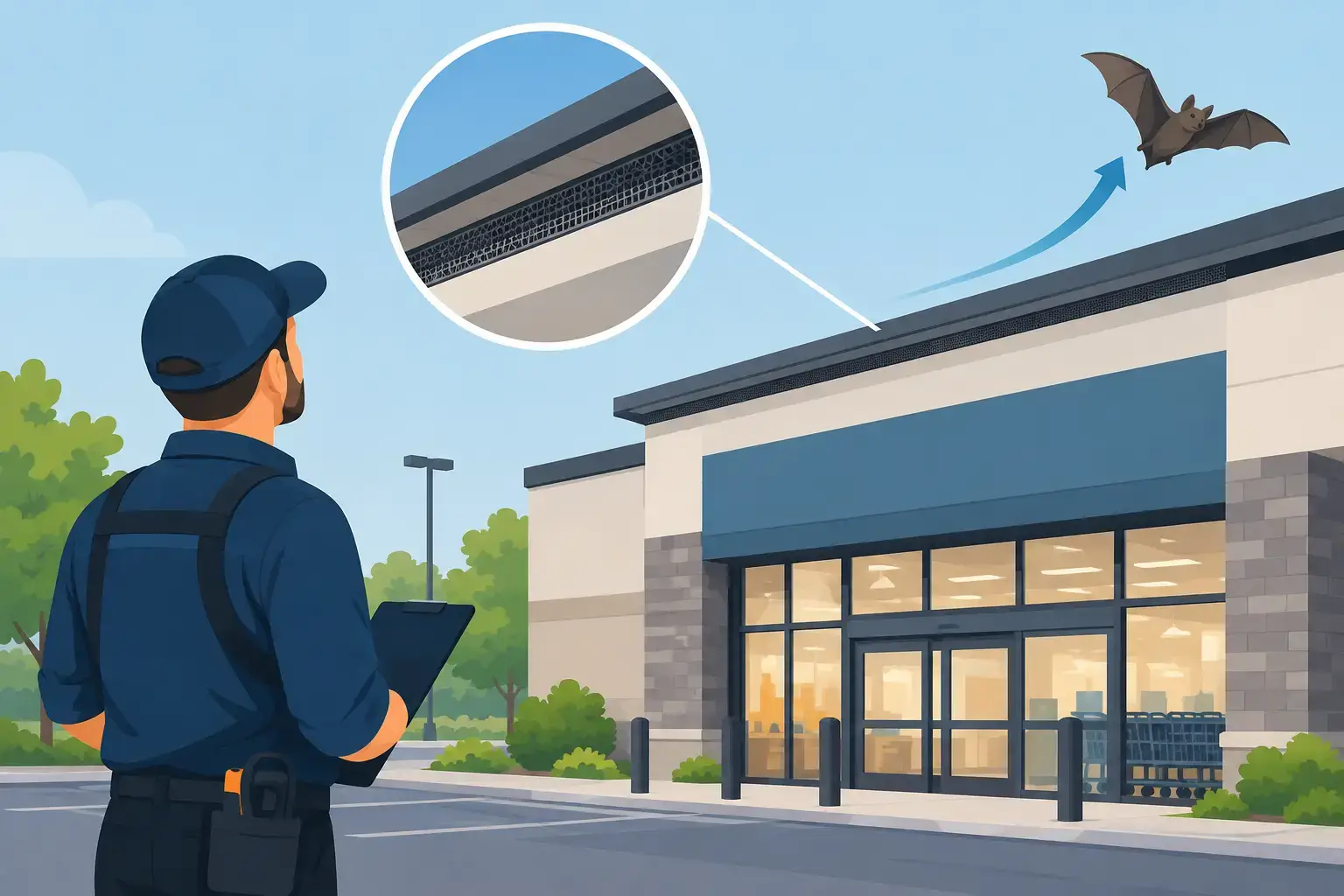
A bat sighting inside a retail store creates an immediate business problem. Customers may leave, employees may feel unsafe, and managers must address sanitation concerns without causing unnecessary disruption. This retail bat exclusion case study reflects a representative commercial scenario: a neighborhood retailer discovered repeated bat activity near its stockroom and needed a humane, lasting answer.
The issue was not solved by removing one visible bat. The building had become accessible to a small colony, and permanent protection required careful inspection, properly timed exclusion, complete sealing, and attention to contaminated areas. That is the difference between a quick response and a bat-free property.
The Retail Problem: More Than One Bat
The store occupied a single-story commercial building with a retail floor, receiving area, stockroom, and suspended ceiling. Staff first noticed scratching sounds after closing, followed by a bat flying near a light fixture in the rear of the store. A manager removed the immediate concern from the customer area, but further signs pointed to an ongoing issue: droppings below a ceiling access panel, staining around an exterior roofline gap, and intermittent odor in the stockroom.
For a retail operator, those signs require prompt attention. Even when bats avoid people, their presence inside an occupied business can affect customer confidence, employee comfort, inventory handling, and sanitation procedures. The appropriate response depends on where bats are active, whether they have entered occupied space, and whether anyone had direct contact with a bat.
In this scenario, the business also faced a practical constraint. It could not close for several days during a busy sales period. The exclusion plan had to protect staff and customers while allowing the store to maintain normal hours.
Inspection Found the Real Access Points
A proper commercial bat inspection begins outside, not in the ceiling. Bats can enter through openings as small as 3/8 of an inch, often using gaps that building owners would not associate with wildlife activity. In this case, the exterior review identified multiple likely access points along the roofline, including separation at fascia boards, gaps around utility penetrations, and an unsealed transition where two roofing materials met.
The inspection also confirmed why a single visible bat should never be treated as the whole problem. Rub marks and droppings beneath one opening suggested repeated use. The roofline offered a protected route into the attic and ceiling voids, allowing bats to stay out of sight during the day while emerging after business hours.
Interior findings helped define the work area. Guano was concentrated above the stockroom ceiling and near a mechanical chase, rather than across the public sales floor. That mattered because it allowed the service team and property manager to create a focused cleanup and protection plan instead of treating every part of the building as contaminated.
Before any work began, the manager received clear guidance on what not to do. Sealing visible holes immediately could trap bats inside the structure. Using poison or glue traps would be inhumane and does not resolve the entry-point problem. General pest-control methods can also miss the building-specific detail needed for bat exclusion.
The Humane Retail Bat Exclusion Plan
The goal was straightforward: allow bats to leave the building, prevent them from returning, and close every viable route once the structure was clear. This is known as exclusion, and it is the proven method for permanent bat control.
First, non-primary gaps were sealed with durable materials appropriate to the building surface. The team left only the confirmed exit locations open and installed one-way exclusion devices there. These devices let bats exit at dusk but block re-entry. They are not traps, and they avoid the unacceptable outcome of sealing animals inside walls or ceiling spaces.
Timing was a central consideration. Bat exclusion must account for local regulations and the maternity season, when young bats may not yet be able to fly. The right schedule depends on the species, location, weather, and evidence found during inspection. A qualified bat specialist evaluates those conditions before setting exclusion devices, rather than applying the same calendar to every property.
The store remained open during the exterior work. Crews coordinated access around delivery periods and customer traffic, kept work zones controlled, and scheduled the most disruptive portions outside peak hours. For commercial properties, that planning is not an extra. It is part of protecting operations while solving the wildlife issue correctly.
Cleanup Protected the Stockroom and Building
Exclusion stops future activity, but it does not remove existing guano, odor, or insulation contamination. After the bats had exited and the building was secured, the cleanup phase began in the affected ceiling areas.
The team used appropriate protective procedures to remove accumulations without spreading dust through the stockroom. Damaged materials were addressed as needed, and affected surfaces were cleaned and treated to reduce remaining odor. Inventory directly beneath the work zone was moved or protected before cleanup began, giving the manager confidence that merchandise and packaging were handled responsibly.
This part of the job is sometimes underestimated. A store may appear normal after bats leave, but neglected guano can continue to create odor, attract insects, and leave staff concerned about working conditions. Cleanup should be scaled to the actual conditions. A small, isolated deposit needs a different response than long-term accumulation throughout an attic or warehouse ceiling.
What Changed After Exclusion
Once exclusion and sealing were complete, the retailer no longer had bats entering the building at dusk. Staff were able to use the stockroom without hearing activity overhead, and the manager had documentation of the areas inspected, access points addressed, and cleanup performed.
The larger result was operational confidence. Instead of reacting to another bat in the store, the business had a plan that addressed the cause of the issue. That is especially valuable for stores, restaurants, offices, churches, and other occupied commercial buildings where a single wildlife incident can become a customer-service concern very quickly.
The case also illustrates a key trade-off. A rushed repair may appear less expensive at first, but incomplete sealing can lead to repeat activity and another round of disruption. A thorough exclusion requires more careful inspection and proper timing, yet it is designed to provide long-term protection rather than a temporary patch.
Lessons for Retail Property Managers
Retail buildings are vulnerable because they often combine aging rooflines, utility penetrations, loading areas, and large ceiling voids. Maintenance teams may repair a visible opening without realizing bats are using several nearby gaps. A bat specialist looks for the full entry network, not just the hole where activity was first noticed.
Managers should treat these signs seriously: bats seen at dusk near roof edges, chirping or scratching in walls and ceilings, droppings near exterior gaps, stains below soffits, and odor in upper storage or mechanical areas. If a bat is found in a public or employee area, isolate the area when possible and follow applicable public health guidance if there may have been direct contact.
The best time to address a potential entry problem is before the next active season or before a small colony becomes a larger building issue. Routine roof and exterior maintenance can help, but bat-proofing requires close attention to the small gaps that ordinary repairs often leave behind.
CP Bat Mitigation approaches commercial bat problems with safe, humane bat removal, proven exclusion methods, detailed sealing, and an industry-leading guarantee. Every Bat Deserves a Home, Just Not Yours.™
If your store has seen a bat, heard activity above the ceiling, or found signs around the roofline, do not wait for a customer to discover the problem first. A professional inspection can identify what is happening, protect your operations, and give the bats a way out without giving them a way back in.