

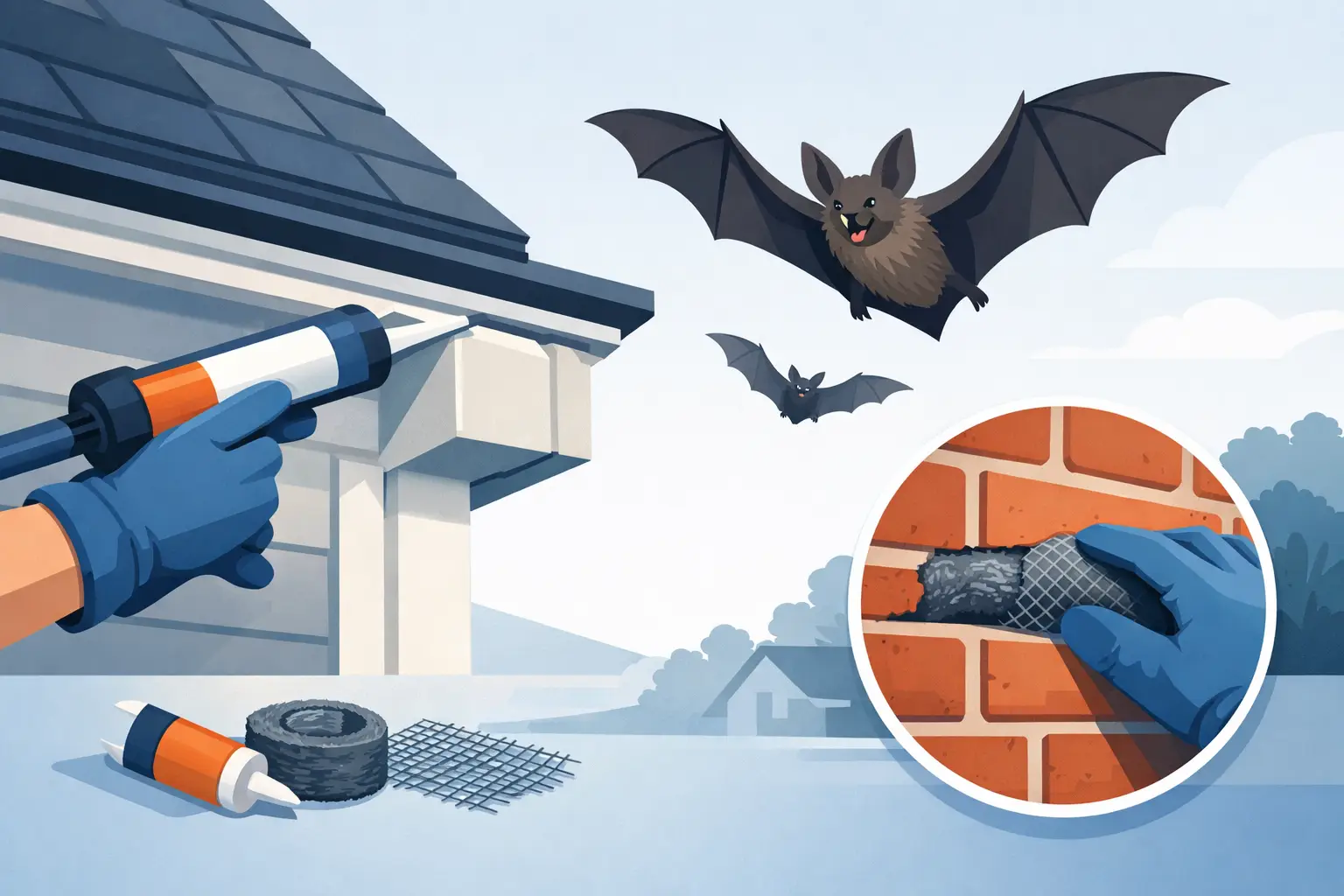
If you have bats getting into your attic, soffits, or wall voids, learning how to seal bat entry points starts with one critical fact: sealing too early can trap live bats inside. That mistake turns a manageable problem into a bigger one, with bats ending up deeper in the structure, odors from dead animals, and a colony that finds new gaps you missed. The right approach is not just closing holes. It is identifying every active and potential opening, excluding the bats safely, and then sealing the structure so they cannot return.
That distinction matters for homeowners, property managers, churches, and commercial facilities across the Midwest. Bats can enter through gaps as small as 3/8 of an inch, which means the vulnerable spots are often not obvious from the ground. A ridge vent, fascia return, chimney gap, loose flashing edge, or construction seam may look insignificant, but to a bat colony it is a working doorway.
How to seal bat entry points without trapping bats
The safest and most effective bat-proofing job happens in stages. First, confirm where the bats are actually getting in and out. Then allow them to leave through one-way exclusion devices. Only after they are out should those openings be permanently sealed.
This is why general pest-control methods often fail with bats. Poison is not an answer, and simple hole-patching rarely works if the colony is still active. Humane bat control depends on timing, attention to detail, and understanding bat behavior around the structure.
Start with a full structure inspection
A proper inspection is broader than finding one hole near the attic. Most bat problems involve a network of openings, including primary exits and secondary gaps that may become active once the main route is blocked. On homes and commercial buildings, the most common areas include rooflines, dormer intersections, gable vents, ridge caps, soffit-to-wall transitions, warped siding, loose trim, and gaps around masonry or utility penetrations.
Look for staining, rub marks, guano below a gap, and grease marks where bats repeatedly squeeze in and out. At dusk, watch the building carefully. Evening emergence often reveals the true active entry points better than a daytime check alone.
Identify active versus potential entry points
This is where many do-it-yourself efforts go wrong. Not every gap is currently being used, but any gap large enough for bats needs attention. During exclusion, active exits are handled differently from inactive openings. The active holes stay available temporarily so bats can leave through one-way devices. The non-active but vulnerable gaps should usually be sealed first, so the colony cannot simply shift to another section of the building.
That sequencing is what creates a lasting result instead of a short-lived patch job.
The best materials for sealing bat entry points
When people ask how to seal bat entry points, they usually want a product list. Materials matter, but only if the exclusion plan is correct. The best seal is one that fits the building material, holds up to weather, and leaves no flexible edge or weak point that bats can work around.
For many structures, professionals use a combination of high-quality sealant, metal flashing, hardware cloth in select vent applications, and custom-fitted repairs to siding, soffits, or fascia. Expanding foam alone is not a reliable bat exclusion solution for most primary openings. It can break down, be chewed or displaced by other wildlife, and often looks like a quick patch because it is one.
Likewise, screen material has to be chosen carefully. Fine mesh may work in one location but fail in another if it is not securely fastened and weather-resistant. On a church, warehouse, apartment building, or older farmhouse, the right repair may be less about caulk and more about rebuilding a vulnerable architectural gap so it no longer functions as an entry point.
One-way devices come before final sealing
For active openings, one-way tubes, netting, or exclusion devices allow bats to exit naturally at dusk but prevent them from getting back in. This step protects the colony from being trapped and protects the property owner from the fallout of a bad seal-up.
Once activity has stopped and the structure is confirmed clear, those devices are removed and the last entry points are permanently closed. Skip that order, and the results can be expensive.
Timing matters more than most people expect
Bat exclusion is not just about construction details. It also depends on the season. During maternity season, flightless young may be present inside the structure. If entry points are sealed while pups cannot fly out on their own, they are left behind. That creates an animal welfare issue and often a serious sanitation problem inside the building.
This is one of the biggest reasons professional bat work has to be handled with care. A legally and ethically sound exclusion plan considers the species, the colony size, the structure type, and the time of year. What is appropriate in early spring may not be appropriate in summer.
In colder parts of South Dakota, Nebraska, Iowa, and Minnesota, seasonal behavior can also affect where bats are roosting and how visible the activity is. Some buildings show obvious evening flights. Others have intermittent use that requires a more experienced inspection to interpret correctly.
Common places bats get in
On most residential and commercial properties, the trouble spots repeat. Ridge vents are a major one, especially when the vent material has lifted or the ends were never fully secured. Soffit returns and fascia gaps are another common source, particularly on older homes where wood has shifted over time. Gable vents, chimney flashing, roof intersections, and spaces behind trim boards also rank high.
Metal buildings and large commercial sites add a few more challenges. Eave lines, expansion joints, corrugated transitions, and high wall seams can all provide access. Churches often have elevated louvers, steeple voids, and architectural features that create hidden roosting areas well above normal sightlines.
That is why a ladder-and-binocular inspection is not always enough. The higher and more complex the structure, the easier it is to miss a secondary gap that allows the colony to stay established.
Why permanent bat-proofing takes precision
A successful seal-up is rarely about one dramatic repair. More often, it is the accumulation of small corrections made with precision. A half-inch gap left open on the backside of a dormer can undo the rest of the project. So can a warped vent edge or a loose piece of flashing on the opposite end of the roof.
Bats are persistent about returning to known roost sites. If the building still offers a workable opening, they will test it. That is why experienced bat specialists treat exclusion as a whole-structure strategy, not a single-hole repair.
For property owners, this is also where the value of a guarantee becomes clear. If a company is confident in its inspection process, materials, and workmanship, it can stand behind the result. That confidence comes from specialization, not from treating bats like just another nuisance animal.
When DIY sealing makes sense – and when it does not
There are cases where a property owner can address a minor vulnerability, such as replacing a damaged vent screen on a building with no confirmed bat activity. But if you have seen bats entering or exiting, found guano, heard noises in the attic or walls, or noticed repeated activity near the roofline at dusk, this has moved beyond basic maintenance.
The risk is not just missing a gap. It is sealing during the wrong season, overlooking hidden exits, or pushing bats into occupied spaces. Homes with steep roofs, multi-story sections, masonry details, or previous failed repairs deserve a professional plan. The same is true for apartment buildings, agricultural facilities, offices, schools, and churches where liability and sanitation concerns are higher.
A specialist such as CP Bat Mitigation approaches that problem with proven exclusion methods, humane handling, and repairs designed for long-term protection. That is a very different service from simply covering a hole and hoping the issue is solved.
After sealing, do not ignore cleanup and monitoring
Once the entry points are sealed, the job may still not be finished. Guano accumulation can damage insulation, create odor issues, and support unhealthy conditions inside attics or wall voids. If the colony was established for any length of time, cleanup matters almost as much as exclusion.
Monitoring also helps confirm the work performed as intended. A reputable exclusion process includes follow-up verification that bats are no longer using the structure and that no overlooked openings remain active. Especially on larger buildings, that extra check is part of doing the job right.
If you are trying to figure out how to seal bat entry points, the smartest next step is not reaching for foam or caulk. It is making sure you know exactly where the bats are entering, whether young are present, and how to remove the colony safely before the structure is closed up. Every bat deserves a home, just not yours.