

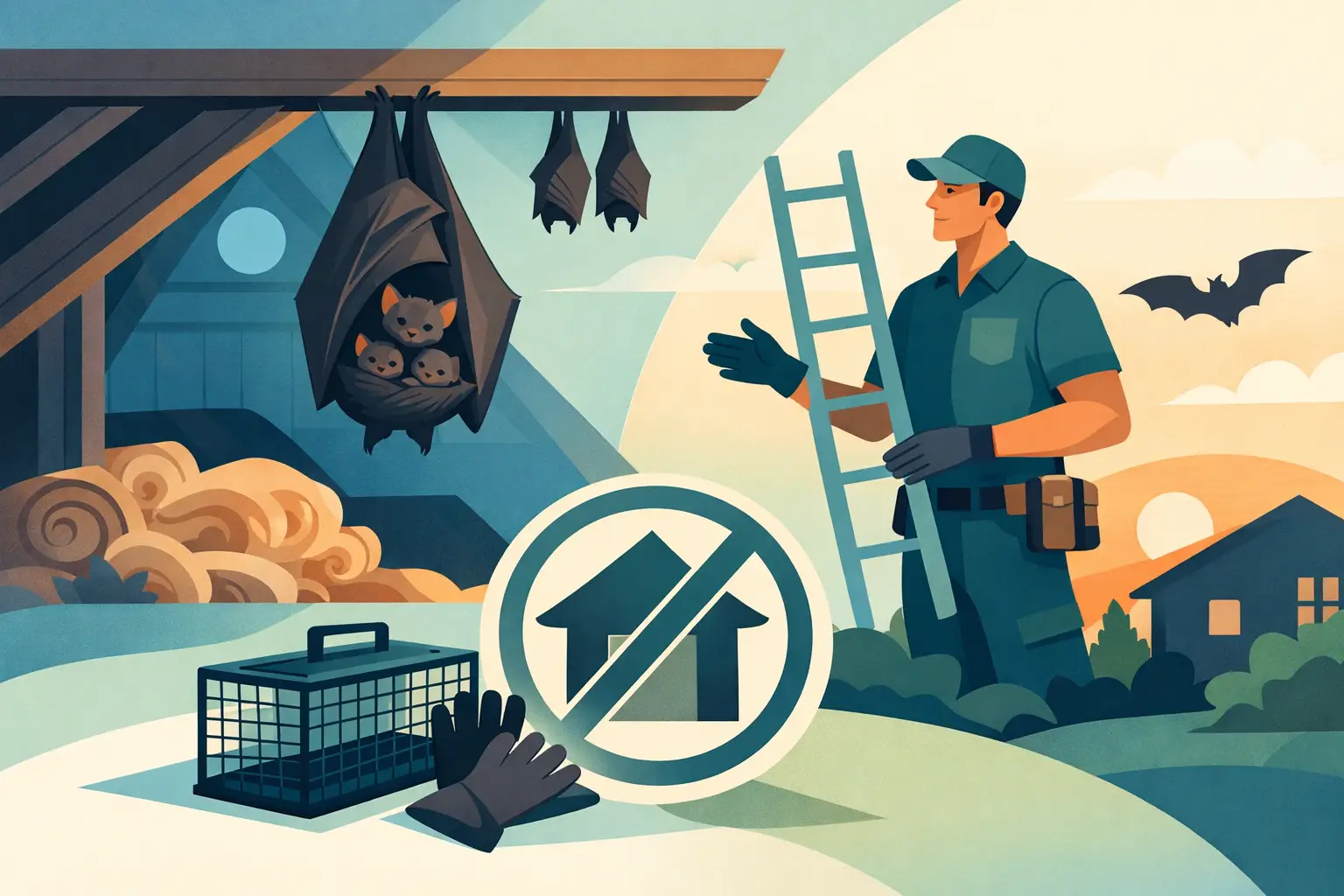
You hear scratching above the ceiling at dusk, then spot a few bats slipping out from the roofline. That is when bat maternity season removal becomes a very different conversation than standard bat exclusion. If there are flightless pups inside, sealing the structure too soon can trap young bats in the attic or walls, creating odor, contamination, and a much bigger problem for the people inside the building.
For homeowners, property managers, churches, and commercial property operators, this is where expert handling matters most. Bat work is not just about getting animals out. It is about knowing when removal can happen, when it must wait, and how to protect both the structure and the colony during that process. Humane bat control depends on timing, species behavior, and a complete exclusion plan.
What bat maternity season removal really means
During maternity season, female bats gather in protected spaces to give birth and raise their young. Attics, wall voids, soffits, and church steeples are ideal because they are warm, dark, and usually undisturbed. The young pups cannot fly right away, so even if adult bats can exit on their own, the babies remain behind for a period of time.
That is why bat maternity season removal is not simply a matter of placing one-way devices and sealing entry points the same week you hear activity. In many cases, full exclusion has to be delayed until the young are able to fly. If not, the result can be trapped pups, distressed adult bats searching for a way back in, and dead animals decomposing inside the structure.
This is also why general pest control methods are a poor fit for bat problems. Bats require species-specific knowledge, legal awareness, and humane exclusion practices. A specialist understands the difference between urgent inspection work and the proper timing for final removal.
Why timing matters so much
The biggest mistake property owners make is assuming every bat problem should be solved immediately the same way. With rodents or insects, fast elimination is often the goal. With bats, timing can change the entire approach.
In the Upper Midwest, maternity season generally falls in late spring through summer, though the exact timing depends on species, weather, and local conditions. That means a house in South Dakota may not line up exactly with one in Iowa or Minnesota. It also means there is no responsible one-size-fits-all calendar date for exclusion.
An experienced inspection determines whether the colony is using the structure as a maternity roost, where the primary and secondary entry points are located, and whether young bats are present. From there, the plan may involve immediate safety recommendations, contamination control, and scheduling exclusion for the right window.
That delay can frustrate property owners, especially if there is noise overhead or guano building up below an entry point. But waiting is often the safer and more effective move. Humane work now prevents a larger cleanup later.
What a professional looks for during inspection
A proper bat inspection is more than spotting one gap near the roof. Bats can enter through very small openings, and most infestations involve more than one access point. During maternity season, the inspection has to answer a few critical questions.
First, where are the bats entering and exiting? Dark staining, guano accumulation, rub marks, and evening flight patterns help confirm active points. Second, is the structure housing a nursery colony? The number of bats, the time of year, and where activity is concentrated all help tell that story. Third, are there conditions inside the attic or wall cavities that raise sanitation or safety concerns?
This matters because successful removal depends on identifying every gap that could allow re-entry after exclusion begins. Sealing only the obvious hole rarely works. The bats simply shift to another opening, and the building owner ends up paying twice for the same problem.
Bat maternity season removal and humane exclusion
Humane bat control does not mean ignoring the infestation. It means using proven exclusion methods at the correct time. Once the pups are old enough to fly, one-way devices can be installed at the active exits so bats leave naturally and cannot get back in. Then the rest of the structure can be sealed to prevent future access.
That sequence matters. If you seal too early, you trap animals inside. If you leave secondary gaps open, they may find another way back in. If you use repellents or shortcuts, the colony often relocates deeper into the structure instead of leaving for good.
A complete exclusion also addresses long-term prevention. Roofline intersections, fascia gaps, construction joints, ridge vents, and chimney transitions are all common weak points. The goal is not temporary relief. The goal is a bat-free structure backed by workmanship that holds.
What property owners should do during maternity season
If you suspect bats during the maternity period, the right move is not to start sealing holes on your own. It is also not a good time to set traps, spray chemicals, or disturb a colony in the attic. Those actions often make the situation worse.
What you can do is limit direct contact, keep people and pets away from any grounded bat, and document what you are seeing. Notice where the bats exit at dusk, whether droppings are appearing on siding or walkways, and whether sounds are concentrated in one section of the building. That information helps an inspection move faster.
If a bat is found inside the living space, especially in a bedroom or around a sleeping person, treat that as a priority situation. The response may be different from standard attic activity because health guidance can come into play. In those cases, professional help should be requested right away.
The hidden costs of getting it wrong
The biggest risk in poorly handled bat work is not just that the bats come back. It is that a manageable issue turns into structural and sanitation damage.
Guano can accumulate quickly beneath active roosting areas. Over time, that buildup can create strong odor, attract insects, and stain ceilings or insulation. In commercial and institutional settings, the stakes are even higher because contamination concerns can affect occupants, maintenance schedules, and public-facing areas.
There is also the issue of repeated infestations. When exclusion is partial or poorly timed, bats often return to the same structure year after year. That creates a cycle of noise, mess, and emergency calls that never really solves the source of the problem. A specialist breaks that cycle by treating the building as a system, not just a single hole in the roofline.
Why specialist experience matters
Not every wildlife company handles bats at the same level, and not every pest company should. Bat work requires a narrow skill set – identifying species patterns, reading architecture, understanding seasonal restrictions, and carrying out exclusion without creating new risks.
That is where focused experience becomes valuable. A company that deals with bats every day can explain what is happening in plain language, set realistic expectations, and map out the right next step instead of forcing the wrong fix at the wrong time. For Midwest property owners, that local knowledge matters because building styles, weather swings, and bat activity patterns vary across the region.
At CP Bat Mitigation, that specialist approach is the point. Safe, humane bat removal, proven exclusion methods, and long-term prevention all depend on doing the work in the right order.
When removal can happen now and when it has to wait
This is the part most people want answered quickly, and the honest answer is: it depends. If the issue is a single bat in a living space, removal may be handled immediately. If the issue is an established attic colony during maternity season, full exclusion may need to wait until the young are volant, meaning able to fly.
That does not mean nothing happens in the meantime. An inspection can confirm the colony status, identify all active entry points, help reduce immediate risk, and prepare the structure for the exclusion window. In some cases, sanitation planning and guano cleanup can also be part of the process once removal is complete.
The best outcome usually comes from patience paired with a clear plan. Rushed work creates avoidable damage. Informed work creates a permanent solution.
If you are hearing bats overhead or seeing them leave your building at dusk, the smartest next step is not guessing the season from an online chart. It is getting the structure inspected by someone who knows exactly what to look for and how to protect both your property and the bats that should not be living in it.