

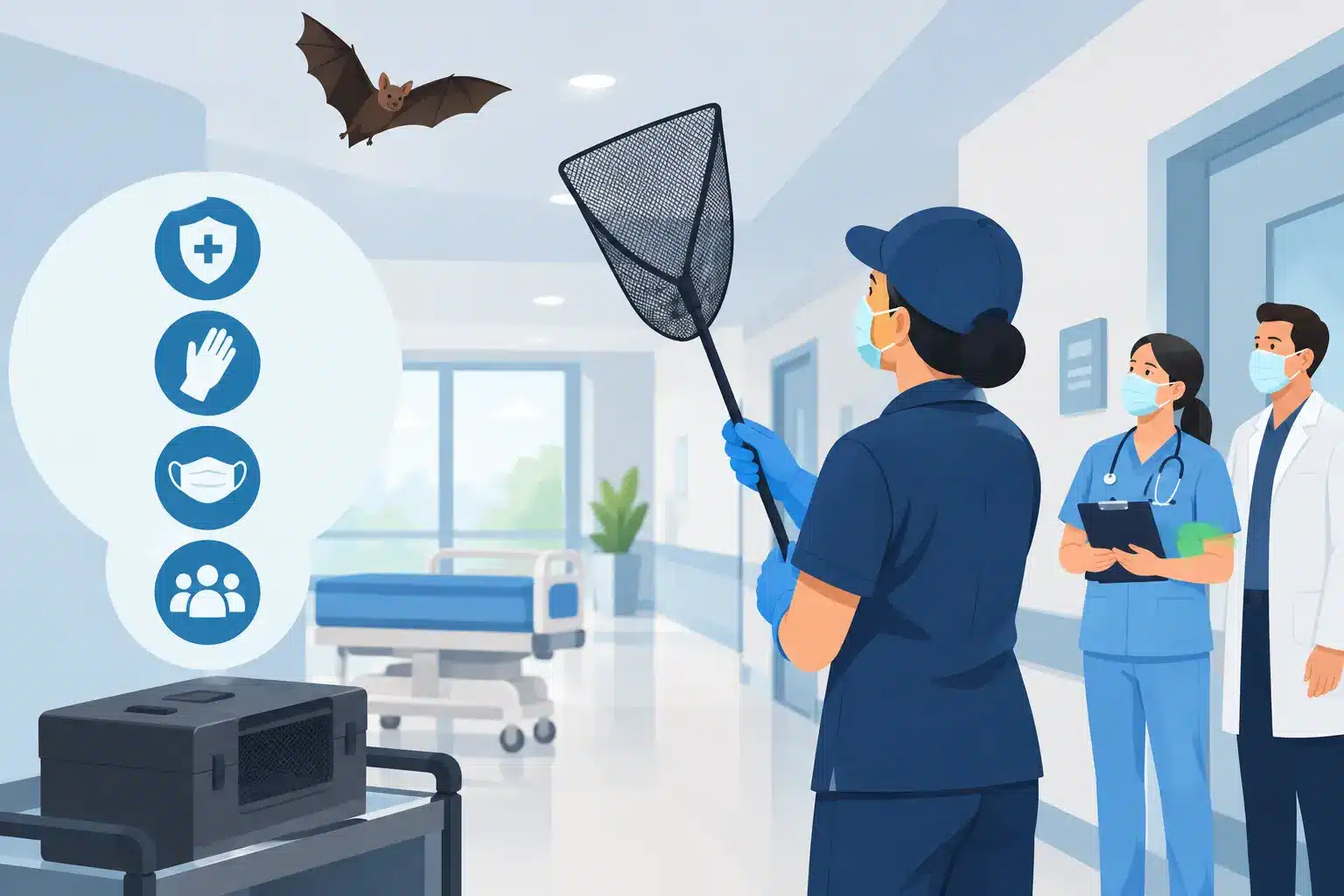
A hospital bat response example is most useful when it is clear enough to guide staff during a stressful moment. A bat flying through a patient room, clinic hallway, chapel, cafeteria, or mechanical area requires a calm, documented response that protects people first while ensuring the animal is handled humanely.
Hospitals cannot treat a bat sighting like a routine pest-control call. Patients may be asleep, sedated, unable to communicate, or medically vulnerable. Staff also have infection-control duties, safety procedures, and public confidence to consider. The right response separates the immediate event from the larger building issue: safely manage the bat, evaluate possible exposure, then identify and close the entry point so the problem does not repeat.
Hospital Bat Response Example
The following example can be adapted into a facility-specific policy. It is not a substitute for direction from hospital leadership, infection prevention, local public health officials, or animal control authorities when a potential human exposure has occurred.
Situation
At 2:15 a.m., a nurse observes a bat flying near a patient room on a medical-surgical floor. The patient had been sleeping. Two staff members were present, and the room door was open to the hallway.
Immediate response
The charge nurse calmly moves visitors and nonessential staff away from the area. The patient is kept in the room if doing so is clinically appropriate, while the room door is closed to limit the bat’s movement into additional areas. Staff should not swat at the bat, chase it through the hall, or attempt to catch it with bare hands.
Security, facilities, and the hospital’s designated safety or infection-prevention contact are notified immediately. If the bat lands, staff keep visual contact from a safe distance and prevent others from entering the room. If the bat leaves the room, staff note its direction of travel and close nearby doors where possible.
The hospital should contact the appropriate local public health authority or animal control agency for guidance on possible exposure and whether the bat should be safely captured for testing. Decisions about medical evaluation and rabies post-exposure prophylaxis belong to qualified medical and public health professionals. A bat that had contact with a person, or was found in a room with someone who may not reliably report contact, should never be released before those authorities have been consulted.
Documentation and exposure review
The incident commander or designated department lead documents the time, exact location, people present, patient condition, observed bat behavior, and every action taken. The record should also include whether the bat was contained, captured by authorized personnel, released, or lost from view.
An exposure review matters because a bite or scratch may not be noticed, particularly when a person is sleeping, impaired, or unable to clearly communicate. The review should identify patients, visitors, and staff who were in the room or immediate area. It should not rely on assumptions such as, “No one saw contact, so there was no risk.” Public health guidance should direct the next step.
Facility response after the event
Once the immediate safety issue is controlled, facilities staff should inspect the affected room and surrounding building envelope. The goal is to determine how the bat entered the occupied area. A lone bat can enter through an open door, but it can also indicate an active roost in a wall void, attic, roofline, chimney, loading area, or mechanical penetration.
The inspection should extend beyond the room where the bat was seen. Bats commonly move through concealed spaces before emerging indoors through gaps around pipes, ceiling access points, utility chases, and unsealed joints. Guano on ledges, staining near small openings, chirping or scratching near dusk and dawn, or repeated sightings are all signs that the issue may be larger than one animal.
Why a Hospital Needs More Than a Quick Removal
Removing a visible bat solves only the most urgent part of the incident. If the entry point remains open, another bat may enter the same night or during the next seasonal movement period. For a hospital, repeated sightings can disrupt patient care, create staff anxiety, prompt avoidable room closures, and damage confidence in the facility’s sanitation practices.
A professional bat inspection focuses on the building conditions that create access. Bats can use openings as small as about three-eighths of an inch, especially at roof intersections, fascia returns, attic vents, masonry gaps, louvers, and utility penetrations. Large healthcare campuses can be particularly challenging because additions, service corridors, rooftop equipment, and aging exterior details create many potential entry routes.
The best long-term answer is exclusion, not indiscriminate trapping or poisoning. Humane exclusion allows bats to leave the structure through professionally installed one-way devices while preventing their return. Once the colony has exited and the timing is appropriate, remaining entry points are sealed with durable materials. Timing matters because exclusion should not separate dependent young bats from their mothers during maternity season.
That balance is essential. Every Bat Deserves a Home, Just Not Yours.™ A hospital must protect patients and operations, but it can do so without using methods that create odor, contamination, or animal welfare problems inside the building.
A Practical Hospital Response Protocol
A written protocol should assign responsibility before an incident occurs. Security may control access, nursing leadership may coordinate patient care, infection prevention may guide documentation and exposure review, and facilities may manage the building investigation. The outside bat specialist should be available for inspection and exclusion work, but hospital personnel still need a clear on-site chain of command.
A useful response protocol includes five actions:
- Secure the area. Limit foot traffic, keep people calm, and prevent the bat from moving farther through occupied spaces.
- Protect people from direct contact. Do not handle the animal, use gloves as a substitute for proper capture training, or allow untrained staff to improvise.
- Notify the right internal and public health contacts. Follow the hospital’s exposure and reporting procedures without delay.
- Record the facts. Document locations, timelines, witnesses, patient circumstances, and the bat’s final disposition.
- Arrange a full building assessment. Treat the sighting as a potential access issue until inspection shows otherwise.
This structure keeps the first response focused. It also prevents a common mistake: sending maintenance staff to seal an opening immediately while bats may still be inside. Premature sealing can trap animals in wall cavities or force them into patient-care areas. The proper sequence is inspection, humane exclusion when needed, final sealing, and cleanup of any confirmed guano contamination.
Special Considerations for Patient-Care Areas
A bat in a public lobby is concerning. A bat in an intensive care unit, behavioral health room, neonatal area, operating environment, or room occupied by a sleeping patient deserves an elevated response. The clinical team should determine whether a patient relocation, room closure, environmental services response, or additional infection-prevention measures are needed.
Not every sighting calls for the same level of operational disruption. A bat observed briefly near an exterior loading dock is different from one found in an occupied patient room. The facts, the patient’s ability to report contact, the bat’s location, and public health guidance all affect the response. What should remain consistent is the refusal to minimize the incident or use untrained capture methods.
For commercial healthcare facilities, a specialist familiar with bat behavior can help distinguish between a single accidental entry and evidence of a colony. CP Bat Mitigation performs detailed inspections and uses proven exclusion methods designed to keep bats out for the long term, without relying on temporary fixes that leave facilities exposed to another incident.
Prevention Starts at the Exterior
Hospitals should include bat-risk checks in routine exterior maintenance, especially before seasonal bat activity increases. Rooflines, expansion joints, vents, soffits, wall penetrations, and utility access points deserve careful attention. Areas near mature trees, waterways, older masonry, and warm mechanical spaces may require extra review.
Staff education also reduces confusion. Employees do not need to become wildlife experts, but they should know who to call, why they should avoid direct contact, and why a sighting must be reported even if the bat disappears. A short facilities and safety briefing can prevent a well-meaning employee from creating a bigger problem.
A calm response protects the people inside the building. A thorough inspection protects the building after the immediate concern has passed. When both happen, a hospital can return its attention where it belongs: caring for patients in a safe, trusted environment.