

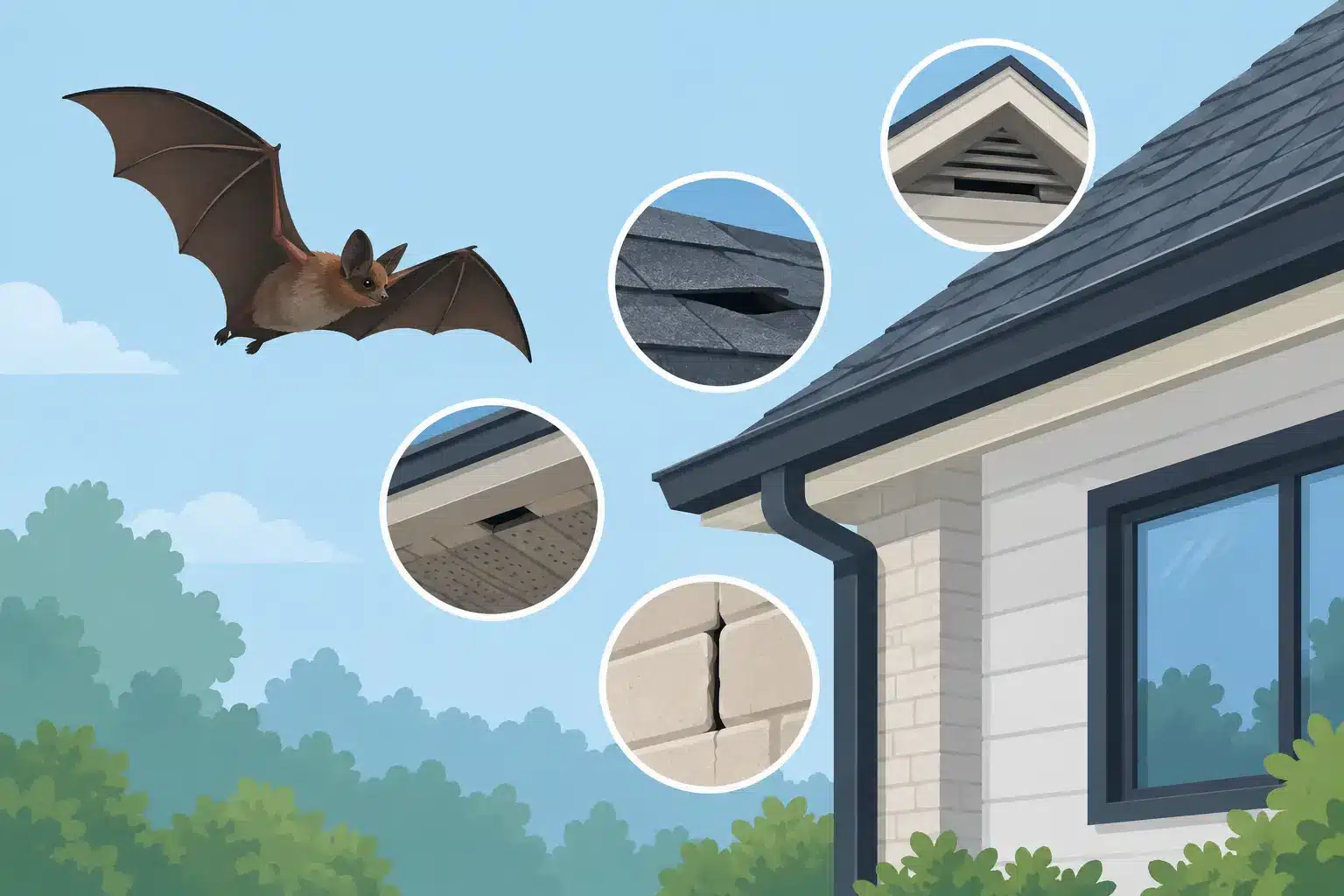
A bat does not need a dramatic hole in the roof to enter a building. Many colonies use openings no wider than a thumb, then return to the same protected gap night after night. Knowing the best bat entry indicators can help you act before noise, odor, staining, and guano become a larger property problem.
For homeowners and building managers, the goal is not to guess at one suspicious crack and seal it shut. The right solution begins by identifying active entry and exit points, locating every secondary opening, and using safe, humane bat removal methods that allow bats to leave without getting trapped inside.
The Best Bat Entry Indicators Are Usually Found Outside
The strongest evidence of an active bat entry point is often subtle from the ground and obvious only during a detailed exterior inspection. Bats favor high, sheltered areas that protect them from weather and predators. Rooflines, chimneys, attic vents, gable ends, siding transitions, and gaps around utility lines all deserve close attention.
A visible opening alone does not confirm bats are using it. Buildings naturally develop gaps as materials age, shift, and expand. What matters is whether an opening shows signs of repeated bat traffic. A trained inspector evaluates the opening itself, the surfaces around it, and the activity occurring at dusk.
Rub marks and oily staining
Bats have natural oils in their fur. As they squeeze through the same narrow opening repeatedly, they can leave dark brown or black smudges along the edges. These rub marks are commonly found on soffits, fascia boards, vent frames, chimney flashing, and siding seams.
Fresh staining is especially useful because it points to a route bats may still be using. However, old marks can remain long after a colony has left, so staining should be evaluated alongside current activity rather than treated as proof on its own.
Droppings below a gap or ledge
Small, dark droppings on a roof, window ledge, deck, exterior wall, or attic insulation can indicate bat activity above. Bat guano is often dry and crumbly when old, and it may contain shiny insect fragments. It is easy to confuse with rodent droppings, particularly when the sample is weathered.
Do not handle, sweep, or vacuum suspected guano without the appropriate precautions. Disturbing accumulated waste can create an unnecessary sanitation concern, and the amount and location of droppings may also reveal whether bats are roosting in an attic, wall void, or commercial roof system.
A gap that is smaller than expected
One of the most overlooked bat entry indicators is the size of the opening. Many common bats can enter through a gap as small as 3/8 of an inch. That means a separation under trim, a lifted shingle edge, a warped vent screen, or a crack at a roof-to-wall transition may be enough.
Property owners often focus on large holes caused by squirrels or raccoons. Those need attention too, but bats commonly choose the narrow, protected gaps that are easy to miss from a ladder or from the ground.
Watch for Bat Activity at Dusk
An exterior inspection becomes much more reliable when paired with a controlled observation at sunset. Bats generally leave their roost shortly after dusk to feed. Watching the building from a safe distance can reveal the exact area where they emerge.
This is not always as simple as seeing one bat fly past a house. Bats may use different openings on different nights, and a single animal outside does not necessarily mean there is a colony inside. Repeated emergence from the same roofline, vent, or wall seam is a much stronger signal.
Pay attention to the direction of flight. Bats exiting from behind a chimney or beneath a soffit can disappear into the evening quickly. A professional inspection may involve observing several sides of the structure, especially on larger homes, churches, apartment buildings, warehouses, and agricultural facilities.
You may also hear activity before you see it. Light chirping, scratching, or fluttering near an attic, upper wall, or chimney can occur around dusk and dawn. Sounds alone are not enough to identify the animal, but they are a useful reason to schedule an inspection.
Common Bat Entry Points on Midwest Properties
Weather extremes across South Dakota, Nebraska, Iowa, and Minnesota can accelerate wear around roofs, siding, and exterior trim. Freeze-thaw cycles, wind, hail, and aging materials can create the narrow openings bats prefer.
The most common access areas include attic vents, ridge vents, gaps behind fascia, loose soffits, chimney caps, roof intersections, dormers, siding corners, and openings around pipes or electrical service lines. Older buildings may also have gaps around brickwork, deteriorated mortar, or unsealed construction joints.
Commercial buildings have their own trouble spots. Flat-roof transitions, parapet walls, expansion joints, loading areas, sign penetrations, and mechanical equipment openings can provide concealed routes into wall systems or ceiling voids. A bat problem at a commercial property is not just a wildlife issue. It can affect sanitation expectations, employee comfort, tenant relationships, and facility operations.
Why Sealing a Suspected Hole Too Soon Can Create a Bigger Problem
It is understandable to want to close a visible gap immediately. But sealing an active primary entry point without a proper exclusion plan can trap bats inside the structure. Trapped bats may move deeper into walls, enter living areas, or die within inaccessible voids.
The safer approach is to identify all potential openings, seal the secondary gaps, and install appropriate one-way exclusion devices on active routes. These devices let bats leave to feed but prevent them from re-entering. Once the bats are out and the structure is confirmed clear, the final exclusion work can be completed.
Timing matters as well. Bat exclusion must be performed responsibly around seasonal maternity periods, when young bats may not yet be able to fly. This is one reason a bat specialist should assess the property rather than relying on a one-size-fits-all repair.
CP Bat Mitigation approaches each project with proven exclusion methods designed for long-term protection. Every Bat Deserves a Home, Just Not Yours.™
When an Inspection Is the Right Next Step
Schedule a professional inspection if you see bats entering or leaving the building, find recurring droppings near the roofline, notice staining around upper exterior gaps, or hear repeated activity in an attic or wall. The same applies if you have sealed openings before and the bats keep returning. Repeat activity usually means one or more access points were missed.
An experienced bat inspection should do more than identify a single hole. It should assess the full exterior, determine whether bats are actively using the structure, identify conditions that invite re-entry, and outline a humane plan for exclusion and cleanup when needed.
Avoid using poison, glue traps, or improvised methods. These approaches can be inhumane, may create odor and contamination problems inside the building, and do not solve the underlying access issue. Permanent bat control depends on exclusion-quality repairs, not a temporary attempt to remove one animal.
If you are unsure whether a mark, gap, or pile of droppings is connected to bats, take note of the location and when you see activity. Then arrange an inspection before the next warm evening turns a small entry point into an established roost.