

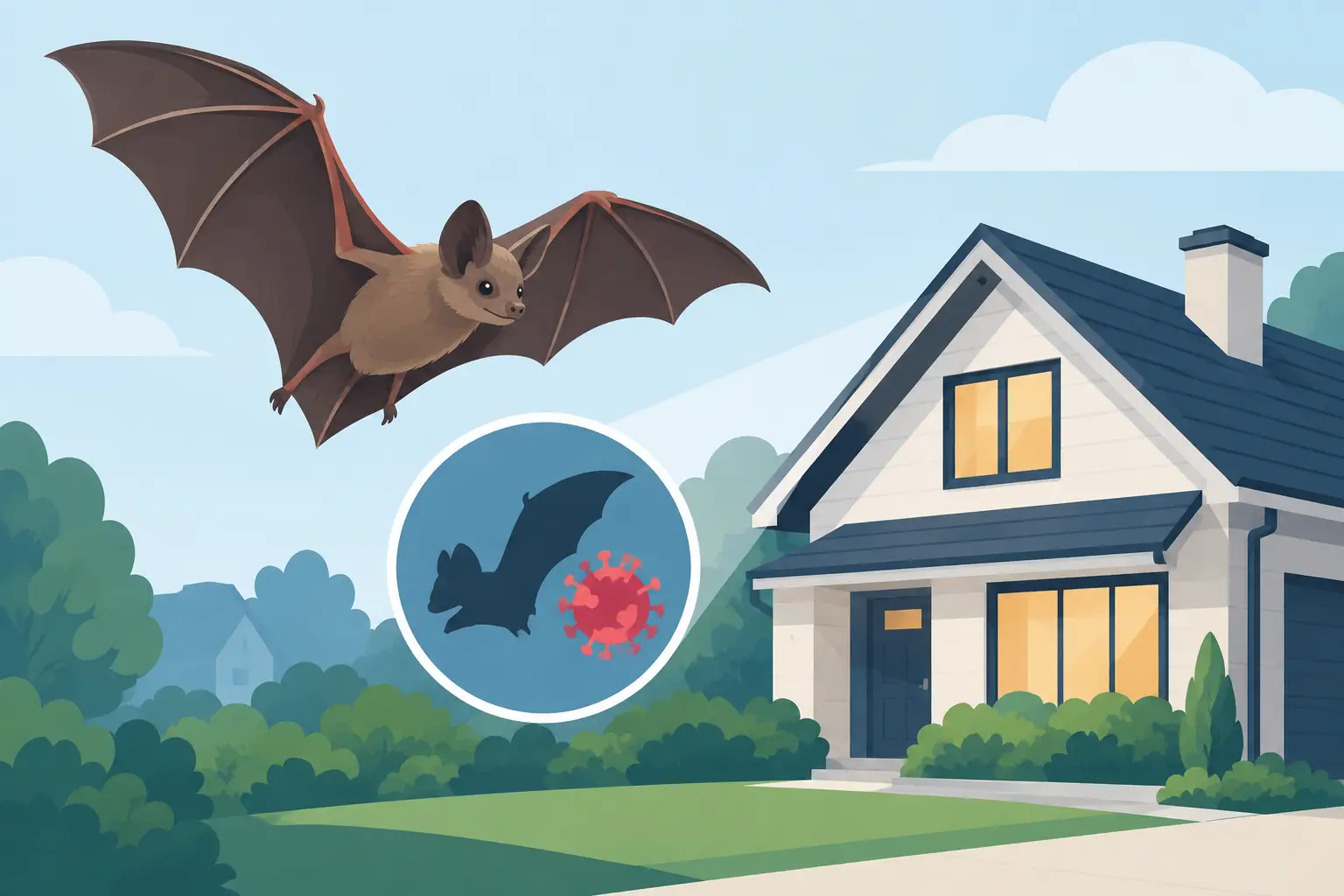
A bat flying through a living room, discovered in a bedroom, or found on the floor can create an urgent question: could anyone have been exposed to rabies? This bat rabies risk guide helps homeowners, property managers, and business operators respond calmly, protect occupants, and address the building conditions that allowed the bat inside.
Most bats do not have rabies. They are valuable wildlife that consume large numbers of insects. Still, rabies is a serious disease, and potential exposure needs prompt advice from a medical professional or local public health authority. The right response protects people without treating every bat sighting as a reason for panic.
When Is a Bat Rabies Risk a Real Concern?
Rabies can be transmitted through saliva or nervous tissue, usually when an infected animal bites or scratches someone. A direct bite, scratch, or saliva contact with the eyes, mouth, or an open wound should always be taken seriously.
The challenge with bats is that their teeth are small. A person may not always notice a bite, particularly if they were asleep, intoxicated, very young, cognitively impaired, or unable to clearly describe what happened. That is why a bat found in a room with a sleeping person, unattended child, or impaired adult is treated differently from a bat observed flying outdoors.
A bat flying outside at dusk is normal bat behavior and is not, by itself, a rabies exposure. Likewise, seeing bats leave a roofline does not mean everyone inside the building is at risk. The concern rises when a bat has been in an occupied indoor space and direct contact cannot be confidently ruled out.
Situations That Call for Prompt Guidance
Contact a healthcare provider or local public health department promptly if someone was bitten, scratched, touched a bat, or woke up to find a bat in the room. Seek guidance as well if a bat was found near a child, an individual who cannot reliably report contact, or a pet that may have interacted with it.
If there was clearly no contact – for example, an alert adult saw a bat fly through an open garage and it left – the situation may not require the same medical response. Public health professionals can help assess the details. It depends on who was present, whether the bat could have made contact, and whether the animal can be safely tested.
Do not assume that a bat is sick based on appearance alone. A grounded bat, a bat active during daylight, or a bat that seems unable to fly should never be handled with bare hands. Those behaviors may result from injury, weather, exhaustion, or illness, but they warrant caution.
What to Do If a Bat Is Found Indoors
Your first job is to separate people and pets from the bat. Keep children away, move pets to another room, and close interior doors if that can be done without cornering or touching the animal. Do not swat at it, chase it, or attempt to pick it up with a towel or gloved hand.
If someone may have had contact, wash any possible bite or scratch thoroughly with soap and water. Then call a healthcare provider or local public health authority for exposure guidance. They can advise whether medical evaluation or post-exposure treatment is appropriate.
When possible, the bat should remain available for professional direction and potential testing. Do not release it before speaking with public health officials if an exposure is possible. Testing may help determine whether treatment is needed. Local agencies can explain the proper procedure for your area and may coordinate safe collection.
If no exposure is suspected and the bat is simply trapped in a room, professional removal is still the safest choice. Opening a window may allow a flying bat to leave, but it does not answer the larger question: how did it get indoors? A single indoor bat can be an accidental entry, or it can be evidence of an active colony in the attic, wall void, chimney, or roof system.
Pets Need Protection Too
Dogs and cats are naturally curious, and a pet may mouth, paw, or catch a bat before anyone sees it. A vaccinated pet has an important layer of protection, but owners should still contact their veterinarian and local animal control or public health office after possible contact. Recommendations vary based on vaccination status, local rules, and the circumstances of the exposure.
Never rely on a pet’s behavior to determine whether a bat was ill. Keep the animal away from the bat and avoid creating a second exposure while trying to investigate. The practical details matter: when the encounter happened, whether the pet physically contacted the bat, and whether the bat can be tested.
The Property Problem Behind an Indoor Bat
A bat in a living area is often the visible part of a hidden access problem. Bats can enter through gaps around rooflines, soffits, fascia boards, gable vents, chimney flashing, utility penetrations, and damaged siding. Small construction gaps can be enough for certain species to enter.
For property owners, the health concern and the building concern should be handled on parallel tracks. Medical or public health professionals address possible exposure. A bat exclusion specialist identifies access points, determines whether bats are roosting in the structure, and develops a humane plan to keep them out for good.
This distinction matters because sealing a hole without understanding bat activity can create serious problems. If bats are trapped inside, they may enter living spaces in search of an exit. If dependent young are present during maternity season, improper timing can separate pups from their mothers. A responsible exclusion plan uses one-way devices that allow bats to exit while preventing re-entry, then seals the structure after activity has ended.
Why DIY Sealing Can Backfire
Homeowners are often tempted to fill visible gaps immediately after seeing a bat. That can be effective only when there is no colony, no hidden entry point, and no seasonal concern. Those conditions are difficult to verify from the ground.
Sprays, repellents, ultrasonic devices, and poison are not reliable answers. They can leave the actual openings untouched, drive bats deeper into wall voids, or create a sanitation issue if animals die inside the structure. Permanent prevention comes from finding the full entry network, excluding bats humanely, and completing detailed repairs.
Safe, Humane Exclusion Reduces Future Risk
The most effective way to reduce recurring indoor bat encounters is to keep bats from entering the building in the first place. That does not mean harming bats. It means giving them a way out and closing the routes that lead into occupied spaces.
A professional inspection should look beyond the obvious opening. Roof transitions, vents, attic louvers, trim gaps, chimney areas, and intersections between additions can all serve as access points. On larger commercial buildings, the process may also involve parapet walls, expansion joints, loading areas, exterior cladding, and mechanical penetrations.
After exclusion, guano and contaminated insulation may need attention. Accumulated droppings can create odors, staining, and sanitation concerns. Cleanup should be approached carefully so material is not unnecessarily disturbed or spread through the building. For churches, apartments, warehouses, and other occupied properties, proper timing and containment can reduce disruption for residents, staff, and visitors.
CP Bat Mitigation focuses exclusively on safe, humane bat removal and proven exclusion methods because a lasting solution requires more than getting one bat out of one room. Every Bat Deserves a Home, Just Not Yours.™
A Practical Response Plan for Property Owners
If you find a bat indoors, stay calm and keep people and pets away. If contact might have occurred, wash the area and seek immediate guidance from healthcare or public health professionals. Avoid releasing or handling the bat before receiving instructions when testing may be needed.
Then address the structure. Document where and when the bat was found, especially if there have been repeated sightings, scratching sounds in walls, droppings in the attic, or bats emerging near sunset. Those details help determine whether the event was isolated or part of a larger roosting issue.
A timely professional inspection can protect your household, occupants, and property from repeat problems. The best outcome is simple: bats leave safely, the building is sealed correctly, and the next unusual sound in the attic does not become another emergency.