

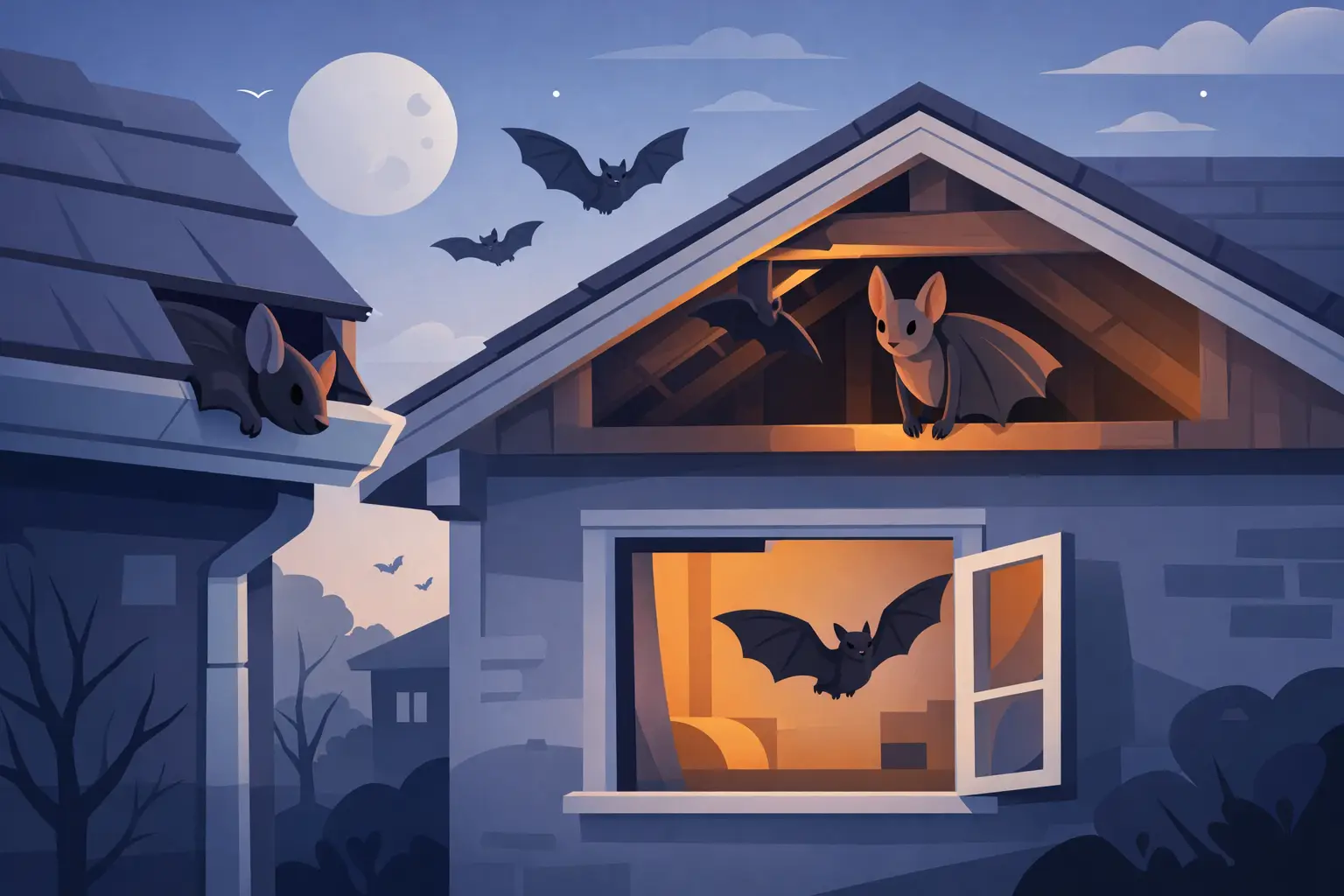
You hear scratching above the ceiling at dusk, or you find a small dark shape hanging near the garage rafters, and the same question comes up fast: how do bats get in house spaces in the first place? Most property owners are shocked by the answer. Bats do not need a wide-open door or a major hole. In many cases, they only need a gap as small as 3/8 of an inch, and they are extremely good at locating warm, sheltered structures that mimic the roosting sites they use in nature.
That is why bat problems often seem to come out of nowhere. The opening may have been there for years, but once a colony identifies your attic, soffit, church steeple, wall void, or commercial roofline as a reliable roost, activity can increase quickly. Understanding where they get in and why they choose certain parts of a building is the first step toward a permanent solution.
How do bats get in house structures so easily?
Bats are not chewing their way into buildings like rodents. They take advantage of construction gaps, aging materials, and design features that already exist. Because they can squeeze through very narrow spaces, an opening that looks insignificant to a homeowner can be a perfectly usable entry point to a bat.
The most common access areas are found high on the structure. That includes loose fascia boards, separated soffits, ridge vents, roof returns, attic vents, chimney gaps, warped siding, openings around utility penetrations, and spaces where roofing materials meet masonry. In commercial buildings, expansion joints, parapet walls, metal roof transitions, and gaps around mechanical equipment can also create ideal access points.
Bats tend to enter where warm air escapes. That air leakage helps them detect sheltered areas that stay stable in temperature, especially during maternity season. If a building has small exterior gaps near an attic or wall void, those spots can act like an invitation.
Why bats choose homes and buildings
A house does not attract bats because it is dirty. In fact, some of the cleanest and best-maintained properties still develop infestations. What bats want is safety, warmth, and a place with limited disturbance. Attics, wall voids, and upper rooflines provide exactly that.
During spring and summer, female bats often look for maternity roosts where they can give birth and raise pups. Those areas need to be warm and protected from predators. That is why south- and west-facing roof sections, upper gables, and sun-heated attic spaces are common trouble spots.
Older homes often have more entry gaps simply because materials shift over time. Newer construction is not immune either. Modern buildings can still have installation gaps around vents, trim, flashing, and roof intersections. The issue is not always age. It is the presence of an opening and the right conditions behind it.
The most common bat entry points
When people ask how do bats get in house attics, the answer usually comes down to a handful of repeat problem areas. Rooflines are one of the biggest. A slight separation where the fascia meets the roof deck can be enough for a colony to come and go.
Soffits are another major entry zone, especially when panels are loose, rotted, or poorly fitted. Gable vents and attic louvers can also allow access if screening is missing, damaged, or improperly installed. Ridge vents may look sealed from the ground but still have usable side gaps.
Chimneys are a special case. Some bats can roost inside open chimneys or use gaps where flashing has pulled away. Wall voids become an issue when siding has warped or utility lines create a pathway inside. In barns, churches, schools, and larger commercial properties, gaps along upper trim, louvers, and roof transitions are especially common.
What makes this difficult is that the active entry point is not always where the bats are being noticed. You may see staining or droppings in one area while the actual opening is several feet away along the roof edge.
Signs bats are getting in
One of the clearest signs is seeing bats emerge at dusk from the same part of the building night after night. They do not usually pour out in a dramatic cloud like people imagine from movies. More often, a few slip out one at a time from a narrow seam near the roofline.
Guano is another strong clue. Bat droppings often collect below entry points, on window ledges, on decks, in attics, or along exterior walls. You may also notice dark staining or oily rub marks around a gap they use repeatedly. A sharp odor in an attic or upper wall area can develop as guano and urine build up.
Sound matters too. Light chirping, rustling, or scratching near dusk and dawn may indicate colony activity. If a bat ends up in the living space, that is a sign there may be an established roost somewhere else in the structure rather than a one-time accident.
Why sealing holes yourself can go wrong
It is understandable to want to close the gap as soon as you find it. The problem is that bat work is rarely as simple as plugging one hole. If even one secondary opening is missed, bats may continue using the structure. If the primary hole is sealed at the wrong time, you can trap bats inside, separate mothers from pups, or drive them deeper into walls and living spaces.
There are also legal and seasonal considerations. Bats are beneficial wildlife and should be removed humanely. During maternity season, exclusion timing matters because flightless young may still be present. This is one of the biggest reasons general pest control approaches often fail. Bat control requires species knowledge, building knowledge, and a full-structure strategy.
A do-it-yourself repair can also create a false sense of success. Activity may stop briefly, only to return through another gap on the same building. By the time the problem becomes obvious again, contamination and cleanup costs may be worse.
What humane exclusion actually looks like
The right solution is not trapping or poisoning bats. It is exclusion. That means identifying every current and potential entry point on the building, sealing the secondary gaps, and placing one-way devices on the active exits so bats can leave but not get back in.
This process has to be precise. If the inspection is incomplete, the colony simply relocates to another opening. If sealing materials are poorly chosen, weather and expansion can reopen gaps. If the work is done during the wrong season, you can create a bigger problem than the one you started with.
That is why specialized bat companies focus so heavily on inspection. The structure must be evaluated from top to bottom, with close attention to architecture, building height, material transitions, and staining patterns that reveal where bats are entering. A proper plan does more than remove current activity. It prevents repeat infestations.
When to call a bat specialist
If you have seen bats around the roofline, found guano in the attic, noticed odor near upper walls, or had a bat appear indoors, it is time for a professional inspection. The same is true if you own a church, apartment building, warehouse, or other large structure where upper-level access points are difficult to see from the ground.
This is not just about removing animals. It is also about protecting insulation, reducing odor, addressing contamination, and preserving the building envelope. Safe, humane bat removal should always be paired with long-term exclusion work, not a temporary fix.
For property owners in the Midwest, this is where a bat-only specialist makes a real difference. Companies like CP Bat Mitigation focus on proven exclusion methods because permanent results come from knowing exactly how bats behave around structures and how buildings fail over time.
How to lower the risk of bats getting back in
After exclusion, prevention matters. Buildings shift, materials age, and weather creates new openings. Routine inspection of rooflines, soffits, vents, fascia, and flashing can catch problems before bats do. If you have had a previous infestation, follow-up checks are especially valuable because bats often return to familiar roosting areas if access is available.
Keep in mind that prevention is not about making a property hostile to wildlife. It is about making the structure unavailable as a roost. That aligns with the humane standard good bat work should follow: every bat deserves a home, just not yours.
If you are asking how do bats get in house spaces, the short answer is through gaps most people never notice. The better answer is that they enter through predictable vulnerabilities, and those vulnerabilities can be found and corrected by someone who knows exactly what to look for. A careful inspection today can spare you months of noise, odor, cleanup, and repeated frustration later.