

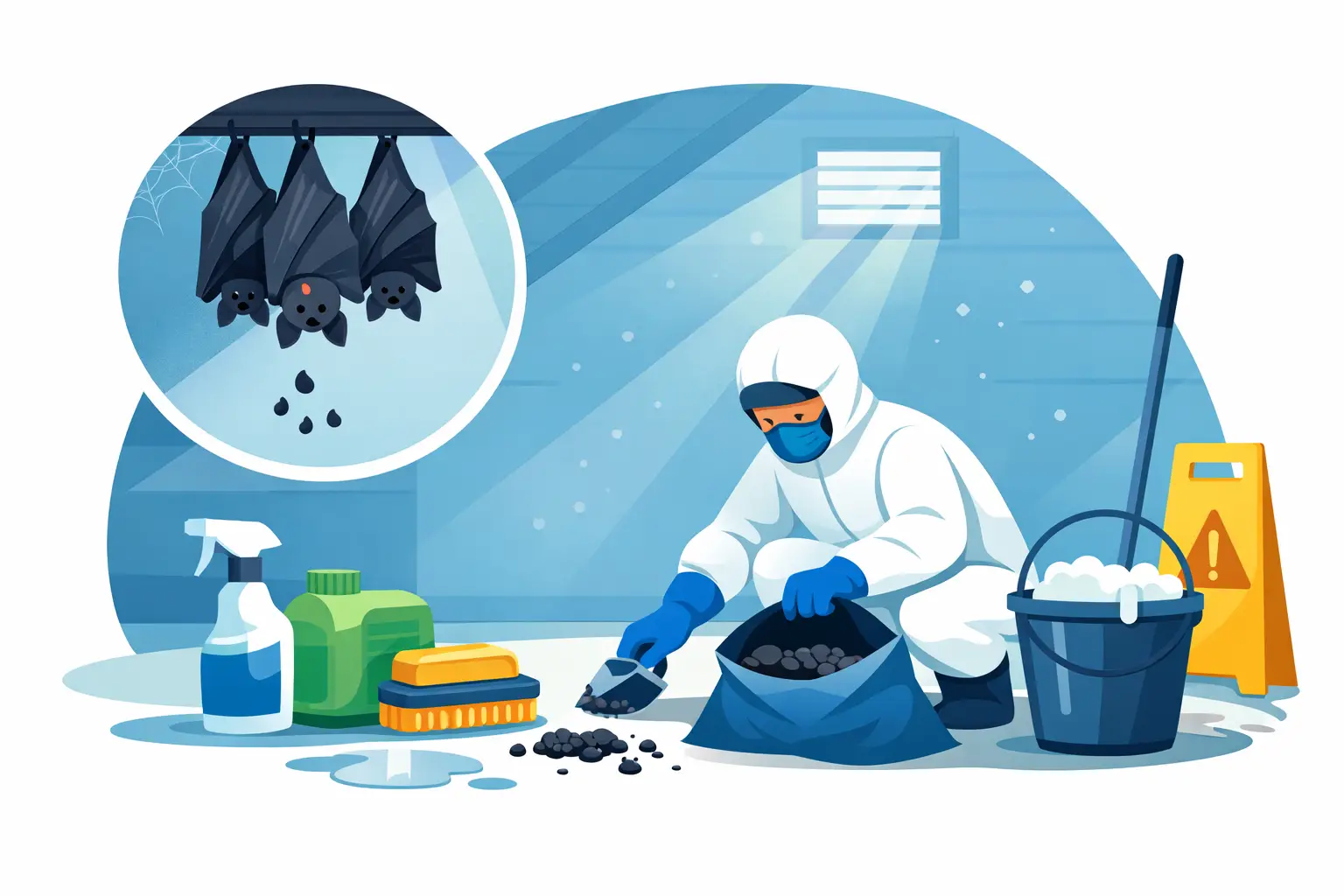
If you found a pile of dry, crumbly droppings in an attic, soffit, barn, or church steeple, the cleanup is not a simple sweep-and-go job. Knowing how to sanitize bat droppings matters because guano can carry health risks, damage building materials, and spread contamination farther when handled the wrong way.
For homeowners and property managers, the first priority is not speed. It is control. Bat droppings should be treated as potentially hazardous material, especially in enclosed spaces where dust can become airborne. If bats are still active in the structure, cleanup also needs to wait until the colony has been properly excluded. Otherwise, the contamination will keep coming back.
Why bat droppings need special handling
Bat guano is different from ordinary household debris. Over time, it can build up in insulation, stain ceilings, create strong odors, and attract insects. When disturbed, dried droppings can release fine particles into the air. That is where the health concern becomes more serious.
One of the biggest risks associated with guano is exposure to fungal spores that may cause histoplasmosis. Not every pile of bat droppings contains harmful spores, but there is no practical way for a property owner to look at guano and know it is safe. That is why professional standards focus on containment, protective equipment, and careful removal rather than casual cleanup.
There is also a structural side to the problem. Heavy guano accumulation can compress insulation, corrode surfaces, and soak into porous materials. In commercial and multi-use buildings, sanitation may also intersect with tenant concerns, workplace safety expectations, and documentation needs.
Before you sanitize bat droppings, stop and assess the space
The right cleanup method depends on where the droppings are located, how much is present, and whether bats are still entering the building. A few pellets on a porch or windowsill are different from years of accumulation in an attic.
If the contamination is light and limited to an open, well-ventilated exterior surface, careful cleaning may be manageable. If the droppings are in an attic, wall void, crawl space, mechanical area, or above occupied rooms, the job becomes much more sensitive. The same is true if you are dealing with large volumes, visible urine staining, odor problems, or damaged insulation.
You should also avoid cleanup if there is any chance of direct contact with a bat. A grounded bat, a dead bat, or a bat found in a sleeping area changes the response. That is no longer just a sanitation issue.
How to sanitize bat droppings safely
If the contamination is minor and the area is safe to access, the process should focus on reducing airborne dust, removing waste carefully, and disinfecting the affected surface.
Start by keeping people and pets out of the area. Open ventilation where possible, but do not use fans that blow directly across the droppings. Air movement can spread particles farther into the structure.
Wear proper protective equipment. At a minimum, that means disposable gloves, eye protection, and a properly fitted respirator rated for fine particulates. A basic dust mask is not the same thing. Clothing should cover exposed skin, and anything worn into the space should be washed separately afterward.
The most important step is to avoid dry sweeping or vacuuming with a standard household vacuum. Both can send contaminated dust into the air. Instead, lightly mist the droppings with a disinfectant or a water-and-disinfectant solution so the material is damp but not splashing. The goal is to keep particles from becoming airborne.
Once dampened, use disposable towels or a scoop to collect the droppings and place them into a heavy-duty plastic bag. Seal that bag, then place it into a second bag and seal again. Double-bagging helps contain residue and odor during disposal.
After the droppings are removed, clean the surface with disinfectant and allow the product to remain wet for the contact time listed on the label. That detail matters. Wiping too soon can reduce the disinfecting effect. On non-porous surfaces, a thorough wipe-down may be enough. On porous materials like unfinished wood, insulation, or acoustic materials, surface cleaning is often not enough because contamination can soak in.
How to sanitize bat droppings in attics and insulation
This is where many do-it-yourself cleanups go wrong. Attics may look accessible, but they are one of the highest-risk places for guano removal. Droppings are often mixed into insulation, tucked between joists, or spread around entry points where bats have roosted for months or years.
In these cases, sanitizing is not just about spraying a surface. It may require removal of contaminated insulation, HEPA-filtered vacuum equipment designed for hazardous debris, and fogging or treatment methods appropriate for the space. Odor control may also be necessary. If the attic has compressed insulation or urine saturation, leaving damaged material behind can continue to affect indoor air quality and energy performance.
There is also the contamination pattern to consider. Bats often enter through tiny architectural gaps, and guano tends to collect below those access points. If the actual entry locations are missed, you may clean the attic only to have the problem restart with the next active season.
What not to do during bat guano cleanup
A few mistakes can turn a manageable problem into a bigger one. Do not sweep dry guano with a broom. Do not use a leaf blower, shop vacuum, or standard household vacuum. Do not power wash enclosed areas. Do not stir up insulation to “see how bad it is” without protection.
It is also a mistake to focus only on sanitation while ignoring the bats themselves. Cleanup without exclusion is temporary. If bats still have access to the structure, droppings will return.
Another common issue is using strong chemicals without a plan. More product does not always mean better sanitation. The wrong cleaner can damage surfaces, create unnecessary fumes, or fail to address porous contamination. Product labels and material compatibility matter.
When professional guano cleanup is the safer choice
For many property owners, the best answer to how to sanitize bat droppings is simple: do not handle significant contamination on your own. Professional cleanup is usually the better option when droppings are widespread, the space is enclosed, bats are or were recently active, or building materials are affected.
That is especially true for schools, churches, apartment buildings, commercial properties, and older homes with complicated attic layouts. In those settings, cleanup often needs to be coordinated with exclusion work, sanitation protocols, and long-term prevention.
A bat specialist will usually inspect the full structure, identify active and historic entry points, determine whether exclusion must happen first, and then recommend the right level of cleanup. In some cases, light surface sanitation is enough. In others, the correct solution includes guano removal, insulation replacement, deodorization, and repairs to keep bats from returning.
That specialist approach is what separates bat mitigation from general pest control. Bats require humane handling, timing considerations, and building-specific exclusion methods. Every Bat Deserves a Home, Just Not Yours.™
How to prevent future bat droppings problems
The real fix is not just cleaning up what is there today. It is stopping the conditions that allowed the guano to collect in the first place. That means sealing entry points after proper exclusion, checking rooflines and vents, and addressing common access areas around soffits, fascia gaps, ridge caps, louvers, and masonry transitions.
Buildings in the Midwest often present seasonal bat activity around attics, barns, warehouses, and church structures. Once bats settle into a reliable roost, the droppings problem usually grows quietly until odor, staining, or noise makes it obvious. Early inspection can prevent a much larger cleanup later.
If you are unsure whether the droppings are old or active, or whether cleanup can be done safely, that uncertainty is your answer. Get the site evaluated before disturbing anything. A smaller, controlled response now is far easier than dealing with widespread contamination, damaged insulation, and repeat bat activity months from now.
Sanitation matters, but so does doing it in the right order. Remove the risk, protect the property, and make sure the cleanup you pay for is the last one you need.