

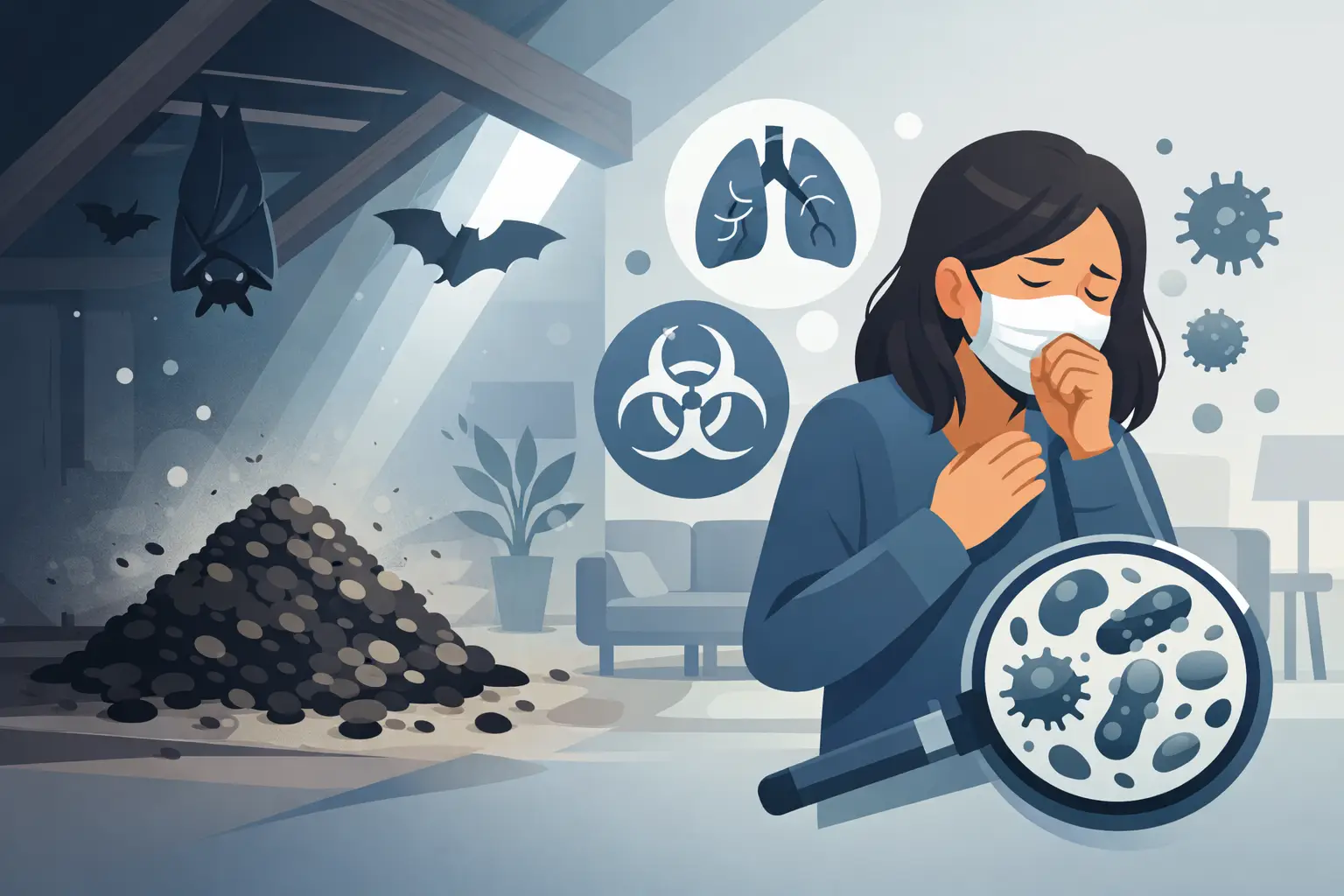
If you have bats in the attic, the problem is not just the scratching overhead. The health risks of bat guano start when droppings build up in insulation, wall voids, soffits, or church steeples and then get disturbed by airflow, cleanup, or renovation work. What looks like a nuisance can quickly become a sanitation issue that affects the people living or working in the building.
At CP Bat Mitigation, we see this concern often across homes, commercial properties, and community buildings. People usually notice the smell first, or staining near an entry point, or dark pellets collecting below a roost. By that point, the guano has often been there longer than anyone realized.
Why bat guano is more than a mess
Bat guano is not the same as a little ordinary debris in an attic. As it accumulates, it can support fungal growth, attract insects, and contaminate insulation and surfaces below the roost. The longer it sits, the greater the chance that routine activity in the building will stir particles into the air.
That matters because exposure does not always happen during a major cleanup. It can happen when someone opens an attic hatch, moves stored items, runs ventilation equipment, or starts repair work near a colony site. In older homes and larger commercial buildings, hidden roost areas make this even more likely because people may disturb contamination without knowing it is there.
The main health risks of bat guano
The best-known concern is histoplasmosis, a respiratory illness associated with fungal spores that can grow in accumulated droppings. When guano is dry and disturbed, microscopic spores may become airborne and be inhaled. Not every guano pile contains this fungus, but the risk is serious enough that no property owner should treat cleanup casually.
For some people, exposure may cause mild or flu-like symptoms, including fever, cough, fatigue, chest discomfort, and body aches. For others, especially older adults, young children, or anyone with a weakened immune system, the illness can become far more severe. People with underlying lung conditions may also be more vulnerable.
Another issue is general indoor air contamination. Even when histoplasmosis is not present, dried guano and urine can break down into fine particles and unpleasant odors that affect indoor air quality. In enclosed spaces, that can aggravate allergies, trigger respiratory irritation, and make the area unsafe to occupy until it has been properly addressed.
Bat waste can also attract secondary pests. Insects drawn to guano deposits may create an additional infestation, adding another layer of sanitation concerns. That does not mean every bat problem turns into a multi-pest problem, but it is common enough that property owners should take the warning signs seriously.
Who is most at risk?
The answer depends on the property and who enters the contaminated area. Homeowners who go into the attic, maintenance staff handling building repairs, contractors opening walls or ceilings, and custodial teams cleaning around access points may all face exposure if they do not know guano is present.
Risk is usually higher for people who spend time in confined areas where droppings have accumulated. The same is true when cleanup is attempted with a shop vacuum, broom, or leaf blower. Those methods can spread contaminated dust rather than remove it safely.
Certain groups should be especially careful. People with asthma, chronic lung disease, compromised immune systems, or a history of respiratory illness have less margin for error. In schools, churches, apartment buildings, and commercial sites, the concern is broader because more occupants may be affected if contamination spreads through shared airspaces.
Signs that bat guano may be creating a health concern
You do not need a massive attic pile for the problem to matter. Small but active colonies can still create unhealthy conditions over time, especially in tight spaces. A strong ammonia-like odor, staining on siding or around vents, visible pellets below rooflines, or black rub marks near entry points can all suggest bats are active and waste is accumulating.
Inside the building, warning signs may include musty smells, discolored insulation, ceiling stains, insect activity near a roost area, or unexplained debris around access panels and rafters. In commercial properties and churches, contamination may collect above drop ceilings, in bell towers, or in mechanical spaces that are not inspected often.
One challenge is that guano can remain a problem even after bats seem to be gone. Old deposits do not become harmless just because the colony moved. If the waste was left behind, the health concern may still be there.
Why DIY cleanup is risky
This is where well-meaning property owners often make the situation worse. Sweeping droppings, bagging them without proper containment, or vacuuming them with standard equipment can send contaminated material into the air. It may also spread residue into other parts of the building.
Household cleaners are not a complete solution either. Spraying the area with disinfectant does not remove contaminated insulation, eliminate all airborne hazards, or fix the bat entry points that caused the problem in the first place. If bats are still getting in, the guano will keep coming back.
There is also a timing issue. Bat removal has to be handled correctly and humanely, especially during maternity season when flightless young may be present. Cleanup without proper exclusion planning can create a worse outcome for both the property and the bats.
Safe response starts with inspection and exclusion
If you suspect bat activity, the safest first step is not cleanup. It is a professional inspection to confirm where bats are entering, where they are roosting, and how much contamination is present. That matters because the visible guano is often only part of the picture.
A bat specialist can identify active entry points, assess whether guano has spread into insulation or wall cavities, and determine whether exclusion can be done right away or needs to be scheduled around seasonal restrictions. Humane exclusion removes bats from the structure without trapping them inside and prevents them from returning.
Once the bats are out, cleanup becomes much more effective. At that stage, contaminated material can be addressed without the colony continuing to rebuild the problem. This is the difference between a temporary fix and a long-term solution.
Health risks of bat guano in homes and commercial buildings
Residential properties often see guano buildup in attics, garages, and soffits, where families may store belongings or access HVAC equipment. In commercial buildings, churches, warehouses, and multi-unit properties, the risk can be more complicated because contamination may be spread across larger areas and affect more occupants.
That means the right response can vary. A single-family home may need focused exclusion and attic remediation. A church or apartment complex may require a broader plan that accounts for occupant safety, maintenance access, and sanitation across multiple spaces. The principle is the same in both cases – remove the bats humanely, contain the contamination, and prevent re-entry.
When to act
Sooner is better. Guano does not improve with time, and bat colonies rarely solve themselves in a way that protects the building. Waiting can lead to deeper contamination, stronger odors, damaged insulation, stained finishes, and more expensive remediation.
It also increases the chance that someone will disturb the area accidentally. A roofer, electrician, maintenance worker, or homeowner pulling down holiday storage may become the first person to realize the problem is serious.
If you have seen droppings, heard bat sounds, noticed odors, or found staining near the roofline, it makes sense to have the property inspected by a bat specialist rather than a general pest company. Bat work requires a different process, and permanent results depend on getting that process right.
A clean, safe property starts with knowing what you are dealing with. If bat guano may be present in your home or building, treat it as a health issue, not just a cleanup chore, and get expert help before a hidden problem becomes a bigger one.