

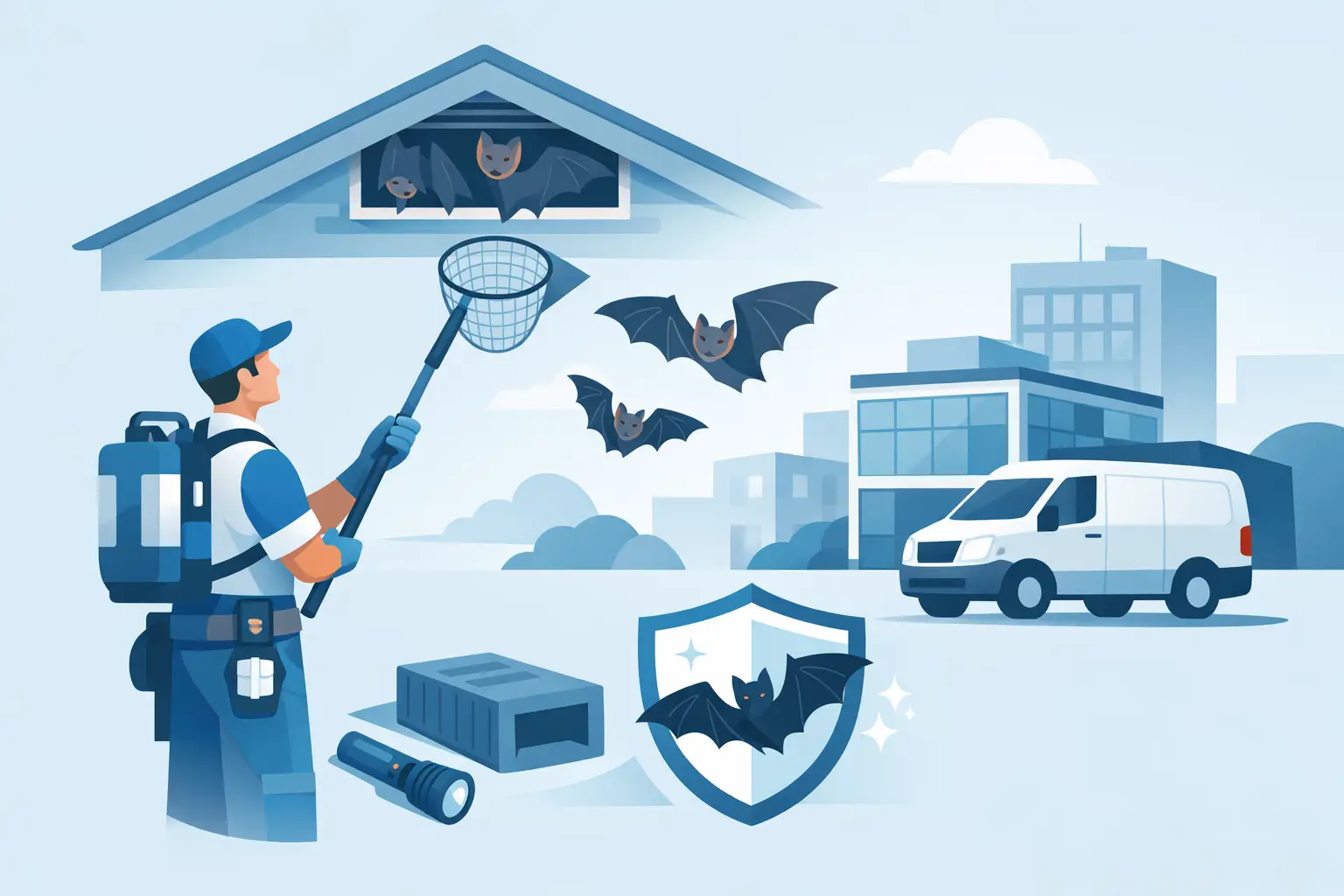
A bat issue in a commercial building rarely starts with a dramatic swarm. More often, it begins with a faint odor in an attic, staining near a roofline, or a maintenance team hearing scratching behind a wall after sunset. By the time tenants, staff, or visitors notice the problem, the colony has usually been there for a while. That is why a true commercial bat removal service has to do more than remove visible bats. It has to find how they got in, protect the building, and keep them from coming back.
For business owners, facility managers, churches, warehouses, and multi-use properties, the stakes are higher than a typical nuisance wildlife call. A bat infestation can affect sanitation, occupant confidence, maintenance schedules, and liability concerns. In many commercial settings, the real cost comes from delay. The longer bats remain in the structure, the more guano accumulates, the more odor spreads, and the greater the chance the colony expands into additional voids and access points.
What a commercial bat removal service should actually include
Commercial bat work is specialized work. It is not the same as spraying for insects or setting traps for rodents. Bats are protected in many situations, and the wrong approach can make the problem worse by scattering the colony deeper into the building or trapping young bats inside during maternity season.
A proper commercial bat removal service starts with a full inspection of the structure. That includes rooflines, soffits, expansion joints, vents, louvers, ridge caps, fascia gaps, and other high or hard-to-reach points where bats commonly enter. Commercial properties often have more complex architecture than homes, which means more potential entry points and more room for missed details if the inspection is rushed.
From there, the plan should focus on humane exclusion. That means allowing bats to exit safely while preventing re-entry. It is a proven method because it solves the problem at the structure level instead of treating the symptoms. If a company talks about poisoning, trapping as the primary strategy, or quick fixes without discussing exclusion, that is a red flag.
Cleanup matters too. Bat guano is not just unpleasant. In larger accumulations, it can damage insulation, create odor issues, stain surfaces, and contribute to unhealthy conditions in enclosed spaces. On a commercial property, cleanup often needs to be coordinated carefully around building use, staff access, and safety protocols.
Why commercial properties are different
A church with a steep bell tower does not present the same challenge as a warehouse with loading bays and metal seams. An apartment complex is different from a retail center. A school, office building, storage facility, and historic structure all require different access methods, timing, and repair strategies.
That is one reason general pest control companies often struggle with bat work on larger buildings. Commercial projects require an understanding of bat behavior, building science, safety access, and long-term sealing methods that hold up under weather and heavy use. The goal is not to patch one visible hole and hope for the best. The goal is to identify the full pattern of use across the building envelope.
It also takes experience to know when timing matters. In some seasons, exclusion work must be planned carefully to avoid separating flightless young from the colony. In active commercial settings, the work may also need to be staged around business hours, worship schedules, resident activity, or facility operations. A good specialist will explain what can be done now, what may need to wait briefly, and how to reduce risk in the meantime.
Signs your building needs bat removal now
Some property owners wait because they have only seen one bat. In a commercial setting, that is not always a small problem. A single bat inside can be the visible part of a larger colony living above ceilings, inside wall systems, or in roof voids.
Common warning signs include bats seen exiting at dusk, droppings below roof edges or in mechanical areas, rubbing marks around small exterior gaps, strong ammonia-like odor, chirping or scratching sounds near ceilings, and repeated bat sightings indoors. If staff members are reporting the same issue from different parts of the property, there is a good chance the colony has more than one access route.
The other sign is recurrence. If you have had bats before and they came back, the earlier work likely did not address every entry point. Commercial structures are unforgiving that way. Miss even a small gap, and the colony may re-establish itself.
The process behind humane, lasting removal
The best commercial bat removal service follows a clear process. First comes inspection and identification. Not every stain or gap points to active bat use, so the technician needs to confirm activity, locate primary exits, and map secondary openings.
Next comes sealing the structure everywhere bats should not be able to use, while leaving the active exits fitted with one-way exclusion devices. These allow the bats to leave naturally but stop them from getting back inside. Once activity has stopped and the colony is out, those final openings are sealed.
After exclusion, cleanup and restoration may follow depending on the level of contamination. In commercial buildings, that can include guano removal, sanitizing affected areas, and replacing contaminated insulation where needed. The exact scope depends on where the colony was roosting and how long it was active.
There is always a balance between speed and thoroughness. Property owners understandably want immediate relief, but permanent bat control is about doing the job in the right order. Cutting corners may feel faster for a week or two, then the calls start again.
Choosing the right commercial bat removal service
Not every wildlife company is built for commercial bat work. Ask direct questions. How much of their work is specifically bat exclusion? Do they inspect the entire structure or only the obvious problem area? Can they handle large or complex buildings? Do they offer guano cleanup? Do they provide a meaningful guarantee on the exclusion work?
You should also listen for how they talk about the bats themselves. Specialists understand that humane treatment and effective removal go together. Every Bat Deserves a Home, Just Not Yours. That mindset leads to better outcomes because it is based on exclusion and prevention, not panic-driven shortcuts.
Experience matters here. A family-owned specialist with decades focused on bats brings a different level of pattern recognition than a general service company. That matters on older churches, multi-building sites, and facilities where one missed detail can turn into another round of contamination and disruption.
CP Bat Mitigation has built its reputation around that kind of specialized work, combining safe, humane bat removal with proven exclusion methods and long-term protection for both residential and commercial properties.
What business owners and property managers can do right away
If you suspect bats, avoid sealing holes on your own before an inspection. That can trap animals inside walls or push them into occupied parts of the building. It is also wise to limit unnecessary access to contaminated spaces such as attics, upper mechanical areas, or storage zones where guano is present.
Document what you are seeing. Note where bats appear at dusk, where droppings collect, and whether odors or sounds are getting worse. For larger facilities, information from janitorial staff, maintenance crews, and tenants can help identify patterns across the building.
Most of all, act early. Commercial bat problems are usually easier and less expensive to solve before the colony expands or contamination spreads. A free inspection from a bat specialist can clarify whether you are dealing with isolated activity or a larger structural issue.
A commercial building has enough to manage without an active bat colony overhead. The right service should leave you with more than fewer sightings. It should leave you with a cleaner structure, clear answers, and confidence that the problem was handled the right way.