

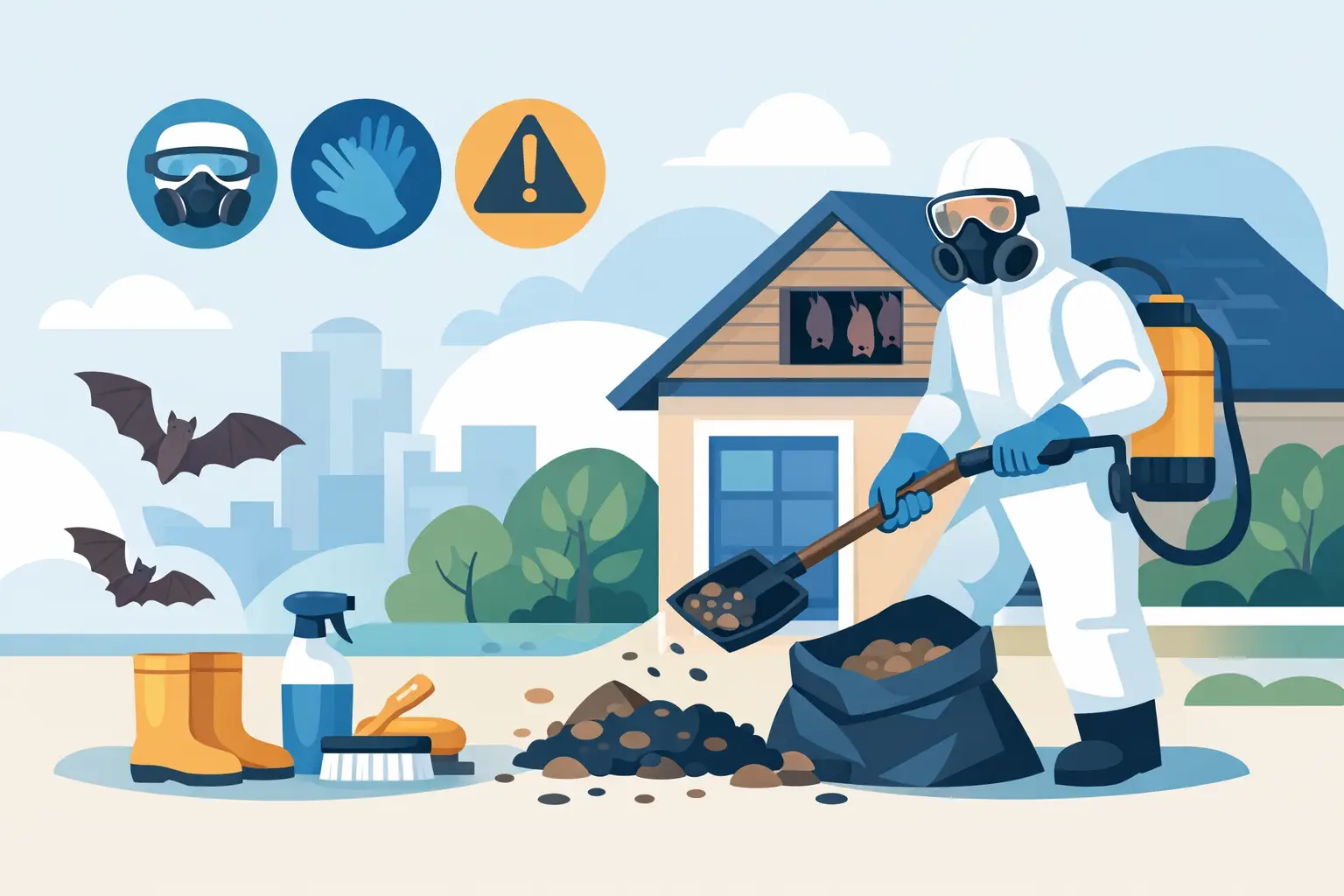
A pile of bat droppings in an attic is not just a housekeeping problem. It can carry health risks, stain insulation and framing, create strong odors, and signal that bats have been active overhead for longer than most owners realize. This guano cleanup safety guide is written for homeowners, property managers, and building operators who need clear direction on what is safe to handle and what should be left to a specialist.
The first thing to understand is simple: disturbing guano without the right protection can make the situation worse. Bat droppings can release fine particles into the air when swept, vacuumed, or shoveled carelessly. In some cases, those airborne particles may expose occupants or workers to harmful contaminants. That is why cleanup is never just about removing visible droppings. It is about protecting people, containing the area, and correcting the bat entry problem so contamination does not start again.
Why guano cleanup safety matters
Bat guano often accumulates in attics, wall voids, barns, church steeples, soffits, and commercial rooflines. In smaller amounts, cleanup may look manageable. In larger accumulations, the risk level changes quickly. The droppings can saturate insulation, soak into wood, attract insects, and produce ammonia-like odors that move into living or occupied spaces.
There is also the question of exposure. If guano has been dry for a while, any aggressive handling can send dust into the air. That is a concern for anyone with asthma, respiratory sensitivity, or a weakened immune system, but it is not limited to those groups. A cleanup plan has to account for everyone who uses the building, including tenants, staff, maintenance teams, and family members.
This is where property owners sometimes make an understandable mistake. They focus on getting the mess out fast instead of approaching the work as a controlled remediation process. Speed matters, but safety comes first.
Guano cleanup safety guide: what not to do
Before talking about proper procedure, it helps to be clear about what should be avoided. Do not sweep dry guano with a household broom. Do not use a standard shop vacuum or home vacuum. Do not enter a heavily contaminated attic in basic work clothes and a paper dust mask. And do not begin cleanup while bats are still present and active in the structure.
Each of those choices can increase contamination or leave the root problem untouched. A household vacuum can spread fine particles. Inadequate masks do not provide the level of respiratory protection needed for many cleanup conditions. Most important, if the bats are still roosting inside, new droppings will continue to build up as soon as the cleanup is over.
That is why exclusion and cleanup are closely connected. Safe, humane bat removal should happen first. Once the structure has been properly sealed and the colony is out, cleanup can be performed with a real chance of lasting results.
Personal protective equipment for guano cleanup
The right protective gear depends on the size of the contamination, how enclosed the area is, and how much material has to be removed. For anything beyond a very minor, isolated deposit, proper PPE is essential.
At a minimum, the person performing cleanup should have respiratory protection appropriate for particulate exposure, disposable or washable protective clothing, gloves, and eye protection. In tight attics or crawlspaces, full-body disposable coveralls are often the better choice because guano dust settles on clothing and can be carried through the home or facility.
Footwear matters too. Shoes or boots used in the cleanup area should be cleaned and decontaminated before walking into clean spaces. In commercial and multi-unit settings, that separation between contaminated and clean zones becomes even more important.
This is one reason many property owners choose a bat-specific cleanup team instead of trying to coordinate the work through general maintenance staff. The issue is not just labor. It is exposure control.
Containment comes before removal
A strong guano cleanup safety guide always starts with containment. If the contaminated area connects to occupied rooms through attic hatches, duct chases, drop ceilings, or wall cavities, the work area needs to be isolated before material is disturbed.
That may include restricting access, sealing off openings between work and living spaces, and controlling how workers enter and exit the area. In some properties, especially churches, schools, offices, and apartment buildings, cleanup timing also matters. Work may need to be scheduled when fewer people are present to reduce risk and disruption.
Ventilation can help, but it has to be managed carefully. You do not want airborne particles pushed from the attic into bedrooms, hallways, sanctuaries, or occupied office suites. The goal is controlled removal, not wider distribution.
Safe removal and disposal methods
Once the area is secured and the right PPE is in place, guano removal can begin. The exact method depends on the depth of accumulation and the materials underneath it. Loose droppings on hard surfaces are a different job than guano that has compacted into insulation or mixed with nesting debris.
In many cases, cleanup involves careful collection and bagging of waste, followed by removal of contaminated insulation or porous materials that cannot be effectively restored. After bulk removal, the area should be detailed to address residual contamination on framing, sheathing, and other structural surfaces.
The key point is that disposal must follow applicable handling requirements, and the work has to be performed in a way that limits dust. This is not a place for shortcuts. If the contamination has spread across a large attic or into multiple connected spaces, the scope can become significant very quickly.
Cleaning, deodorizing, and restoring the space
Removing the visible droppings is only part of the job. Odor-causing residue often remains, and damaged insulation may continue to hold contamination even after the bulk material is gone. That is why post-removal cleaning matters.
Depending on the structure, restoration may include surface treatment, odor reduction, insulation replacement, and checking whether staining or moisture has compromised building materials. Some attics need only partial restoration. Others need a more complete reset to return the space to a safe and functional condition.
There is a trade-off here. A lower-cost cleanup that leaves contaminated insulation in place may save money upfront, but it can leave odors, reduce indoor air quality, and create future complaints. Property managers usually understand this quickly because tenants and occupants do not care that most of the mess was removed. They care whether the problem is actually gone.
When DIY is unrealistic
A small amount of droppings on an exterior porch or isolated window ledge may be one thing. An attic with active or previous colony buildup is something else entirely. If guano is widespread, if insulation is affected, if there is strong odor indoors, or if the cleanup area is enclosed and difficult to access, professional service is the safer path.
The same is true for commercial buildings, apartment properties, churches, and any site where multiple occupants could be affected. In those settings, liability and documentation matter almost as much as the cleanup itself. Owners need confidence that the bats were removed humanely, entry points were sealed, and contamination was handled correctly.
A bat specialist brings another advantage: experience identifying where guano came from and whether the exclusion work is complete. General pest control companies may treat the mess as a sanitation issue alone. In reality, guano cleanup without proper bat exclusion is often just a temporary reset.
Choosing the right help
If you are hiring out the work, ask whether the company specializes in bat exclusion and guano cleanup rather than general pest work. That distinction matters. Bats are not rodents, and the way their entry points, roosting patterns, and legal protections are handled is different.
Look for a provider that can inspect the full structure, confirm where bats entered, explain the cleanup scope clearly, and recommend restoration based on actual contamination rather than guesswork. A family-owned specialist like CP Bat Mitigation brings the kind of focused bat experience that helps owners avoid repeated infestations and incomplete cleanup.
The best cleanup plan is the one that solves the whole problem – humane removal, sealed entry points, safe waste handling, and restoration that protects the property long term.
A practical standard for property owners
The most useful guano cleanup safety guide is not the one that makes cleanup sound easy. It is the one that helps you recognize risk before someone gets exposed or a building gets recontaminated. If droppings are minor and truly isolated, caution and proper protection still matter. If the contamination is moderate to heavy, or tied to an attic colony, this is no longer a simple maintenance task.
Your building does not need guesswork. It needs a safe plan, the right protective measures, and a permanent fix that keeps bats out for good. That is how you protect the people inside and the value of the property above them.