

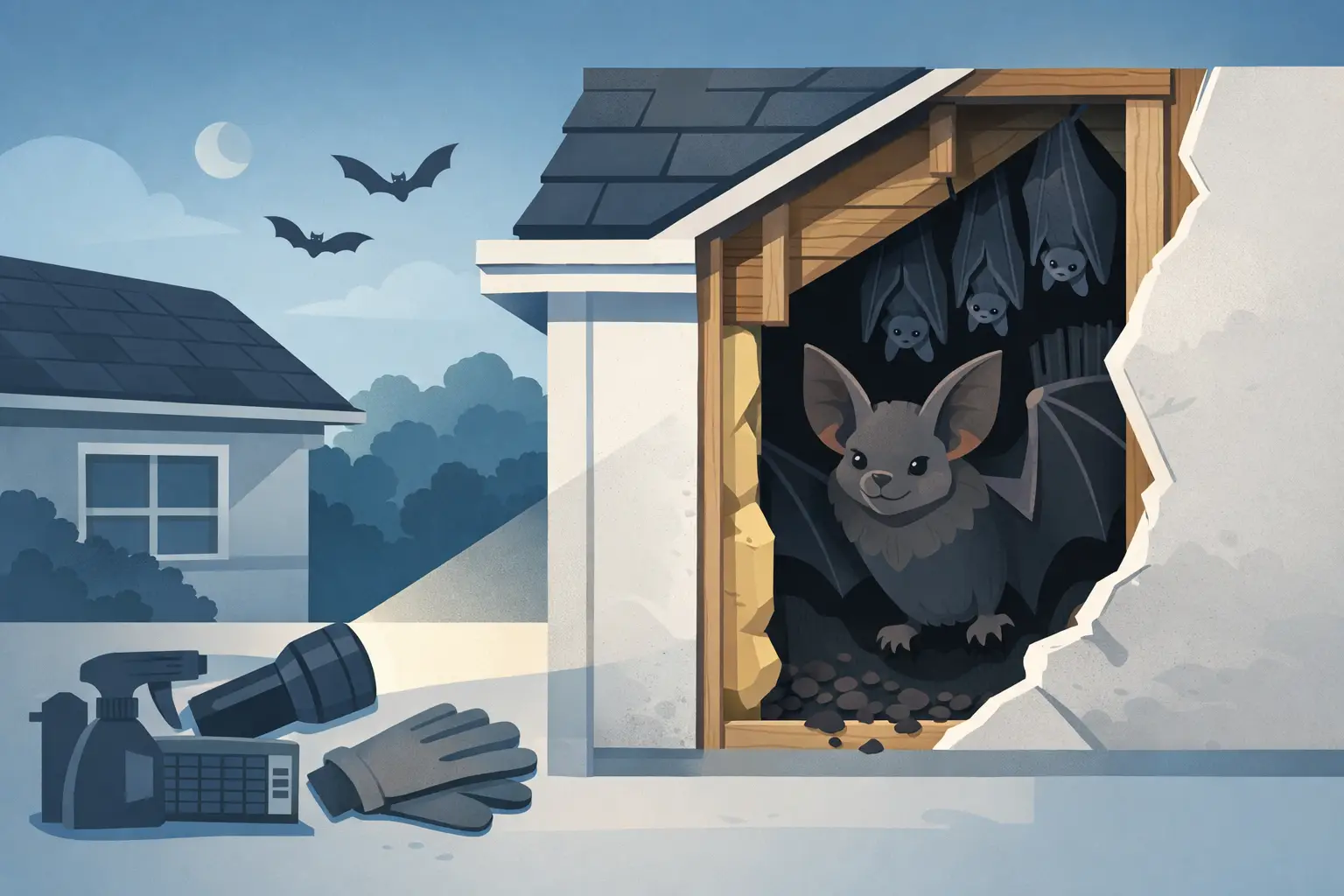
You usually hear it before you see any proof – a faint scratching after sunset, quick fluttering behind drywall, or chirping that seems to come from nowhere. A bat infestation in walls often starts that way, and by the time most property owners realize what is happening, the colony has already settled in.
That matters for more than peace and quiet. Bats inside wall voids can leave behind guano and urine, create persistent odor, stain ceilings and siding near entry points, and raise understandable concerns about health and sanitation. The good news is that this problem can be solved safely and humanely. The key is handling it like a bat issue, not like general pest control.
Why bats end up inside walls
Bats are not chewing their way through your house. They take advantage of existing construction gaps, often as small as a half inch, and use wall cavities because those spaces are dark, protected, and stable. On homes and commercial buildings across the Midwest, common access points include roof edges, soffits, fascia gaps, gable vents, chimney transitions, siding separations, and areas where masonry meets trim.
Once bats find a reliable opening, they tend to return. A maternity colony may use the same structure season after season if the entry points remain open. That is one reason a bat infestation in walls rarely goes away on its own. Even if activity seems to stop for a few days, the colony may still be present or may return at the next favorable weather pattern.
There is also a seasonal factor. In spring and early summer, female bats look for safe nursery spaces to raise pups. Wall voids can provide exactly the warm, sheltered environment they need. Later in the season, activity may become more noticeable as young bats begin moving with the colony.
Signs of a bat infestation in walls
Some signs are obvious. Others are easy to mistake for mice, squirrels, or normal settling noises. The pattern matters.
The most common clue is sound at predictable times. Bats are usually most active around dusk and dawn, so fluttering, rustling, or high-pitched chirping during those windows is a strong indicator. If the noise is concentrated in exterior-facing walls or near the upper floors and attic line, suspicion should go up.
You may also notice staining around an entry point. Bats leave dark, oily marks where their bodies repeatedly pass through the same gap. Below those openings, guano can accumulate on window ledges, porches, decks, siding, or the ground. Bat droppings are small and dark, but they tend to collect in piles where bats roost above.
Odor is another sign that the problem has progressed. A small colony may go unnoticed for a while, but as guano and urine build up in enclosed wall cavities, the smell becomes harder to ignore. In some buildings, property owners first notice the issue after odor begins drifting into living spaces, mechanical areas, or shared hallways.
Then there are the surprise encounters. A bat appearing in a bedroom, office, sanctuary, lobby, or common area can mean the colony is using adjacent wall spaces and has found a path indoors. At that point, the issue needs immediate attention.
Why DIY fixes often make it worse
When people discover bats in the walls, the first instinct is often to seal the hole right away. That sounds reasonable, but timing and method are everything. If bats are sealed inside, they can end up trapped in walls, die inside the structure, or push deeper into the building and emerge in interior spaces.
Repellents are another common mistake. There is no spray, sound machine, bright light, or store-bought shortcut that reliably removes an established colony from wall voids. At best, these methods waste time. At worst, they scatter the bats into harder-to-reach sections of the structure and complicate proper exclusion.
Trapping is not the answer either. Humane bat control is based on exclusion, which allows bats to leave the building and prevents them from getting back in. That approach protects the animals while solving the property problem at its source.
There is also the legal and biological side to consider. During maternity season, exclusion timing may need to be adjusted to avoid separating flightless pups from their mothers. This is one of the biggest reasons bat work should be done by a specialist who understands bat behavior, local conditions, and humane removal standards.
The right way to remove bats from wall voids
A proper solution starts with a full inspection, not just the place where noise is being heard. Bats may be roosting in one section and entering from another. On many structures, there is a primary entry point plus several secondary gaps that would allow re-entry if they are not addressed.
Inspection and identification
The first step is confirming that bats are present, locating active and potential entry points, and identifying where the colony is roosting. That inspection should include rooflines, upper siding transitions, vents, eaves, dormers, chimney areas, and any architectural gap that could serve as access.
This step matters because successful exclusion depends on precision. Missing even one active gap can lead to a failed job and another round of infestation.
Humane exclusion
Once activity patterns and access points are confirmed, one-way exclusion devices are installed on the active exits. These let bats leave naturally at dusk but keep them from getting back inside. At the same time, secondary openings are sealed so the colony cannot simply shift to another gap nearby.
This is the part that separates true bat specialists from general wildlife work. The goal is not to chase bats around the structure. The goal is to control every path in and out until the colony exits safely.
Permanent sealing and prevention
After the bats are out, the remaining openings are sealed with durable materials suited to the building. This is where long-term protection is built. Quick patchwork may hold for a season, but permanent prevention requires matching the repair method to the structure and to the way bats exploit gaps.
Guano clean-up and sanitation
If a colony has been present for a while, cleanup may be needed. Guano and urine contamination can affect insulation, create odor, and leave behind unhealthy conditions in wall cavities, attics, and adjacent spaces. Cleanup is not just cosmetic. It helps restore sanitation and reduces the chance that lingering scent will attract future bat activity.
What to do if you suspect bats in the walls
Start by staying calm and resisting the urge to seal holes yourself. If you can safely observe the outside of the building at dusk, watch for bats exiting from roof edges, vents, or gaps along the upper walls. Do not handle a bat directly, and keep children and pets away from any bat found indoors or on the ground.
If a bat is discovered inside a room where someone was sleeping, or in a situation involving direct contact, treat that as a higher-priority health concern and seek immediate guidance from local health officials and a qualified bat professional.
For the property itself, the next move should be a professional inspection. That gives you a clear answer on whether bats are present, how they are getting in, whether maternity timing affects removal, and what permanent exclusion will involve. For homeowners, property managers, churches, and commercial operators, that clarity is often the difference between a one-time fix and an expensive repeat problem.
Why specialized bat control matters
A bat infestation in walls is not a standard pest issue. Bats behave differently, access structures differently, and require a humane, exclusion-based solution. Experience matters because the details matter – entry-point identification, timing, building type, cleanup needs, and long-term sealing all affect the outcome.
That is why many property owners choose a company focused only on bats instead of a general pest provider. CP Bat Mitigation has built its reputation around safe, humane bat removal, proven exclusion methods, and long-term prevention for homes and commercial buildings across the region. When the job is done correctly, the goal is simple: the bats leave, the building stays protected, and they do not come back.
If you are hearing scratching behind the walls or seeing signs around the exterior, trust that instinct and act early. Bat problems are usually easier to solve before contamination spreads and before a seasonal colony becomes more established.